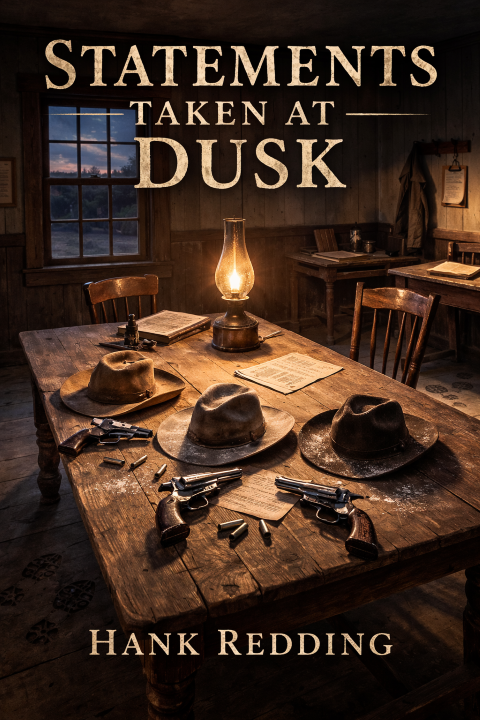
STATEMENTS TAKEN AT DUSK
Montana Territory, 1898
I. The Room
The office was still holding the day’s heat when they came in.
Dust hung in the amber of the lamp. The windows were shut. Outside, town sounds had already thinned to horses shifting and someone hammering loose board against evening wind.
Sheriff Elias Brogan did not stand when the three deputies entered.
He looked first at their boots.
Ash on the leather.
Not road dust.
Not trail grit.
Ash.
“Sit,” he said.
There were four chairs at the long table.
Only three were taken.
The fourth remained angled toward the wall, as if someone had stood too quickly and never turned it back.
Brogan placed his ledger in front of him and dipped the pen into ink.
“Deputy Thomas Hale did not return with you.”
No one answered immediately.
The lamp ticked as the oil settled.
Finally Amos Kline cleared his throat.
“No, sir.”
Brogan did not look up.
“Then we’ll begin.”
II. Deputy Amos Kline
Kline sat upright, hat removed, hands folded as though awaiting church instruction.
He had cleaned his revolver.
Brogan noticed that.
“We left at nine in the morning,” Kline began. “The warrant was clear. Arrest of Samuel Crowe for the killing of Jasper Dill. Witness statements already taken. The ranch was ten miles east. We approached in formation.”
“In formation,” Brogan repeated.
“Yes, sir.”
“Four of you.”
“Yes.”
“Deputy Hale included.”
“Yes.”
Kline paused only long enough to breathe.
“Crowe was in the barn when we arrived. He came out when ordered. He was armed. We instructed him to disarm.”
“And?”
“He did not.”
“Who fired first?”
Kline blinked once.
“Crowe.”
Deputy Edwin Clarke shifted in his chair.
Kline did not look at him.
“Crowe fired. Deputy Hale advanced to the left side of the structure. Deputy Varner held rear approach. I returned fire. Deputy Clarke moved to cover the horses.”
Brogan wrote steadily.
“Deputy Hale disobeyed order,” Kline added.
Brogan stopped writing.
“Disobeyed?”
“I ordered him to hold position. He advanced.”
“You are ranking officer?”
“In the field, yes.”
Brogan’s pen hovered.
“And then?”
“The barn ignited.”
“How?”
“Lantern.”
“Whose lantern?”
Kline hesitated for the first time.
“Crowe’s.”
“And Hale?”
“He chased Crowe through the smoke.”
“Alone?”
“Yes.”
“And you did not follow?”
“The structure was collapsing.”
“And Crowe?”
“Escaped into the tree line.”
“And Hale?”
Silence.
Kline’s jaw tightened.
“We believe he pursued.”
“Believe.”
“Yes.”
“And the two civilians dead?”
“Inside the house. The fire spread.”
Brogan’s eyes lifted.
“The fire began in the barn.”
“Yes.”
“And spread uphill.”
“Yes.”
Brogan’s gaze remained on him longer than necessary.
“Thank you, Deputy Kline.”
III. Deputy Edwin Clarke
Clarke did not remove his hat until Brogan stared at it.
He set it down awkwardly.
His hands were shaking.
“We didn’t go in formation,” Clarke said immediately.
Kline stiffened.
Brogan did not look at either of them.
“Speak only when addressed,” Brogan said to Kline.
Then, to Clarke:
“You disagree?”
“Yes, sir.”
“Proceed.”
Clarke swallowed.
“We rode in single line. Hale was second. He and Crowe knew each other.”
Kline’s head turned sharply.
“That’s not—”
“Deputy Kline,” Brogan said softly.
Kline fell silent.
Clarke’s eyes darted between them.
“Hale and Crowe argued before,” Clarke continued. “About wages. About something owed. Hale said it wasn’t personal, but—”
“Stick to today,” Brogan said.
“Yes, sir.”
Clarke wiped his mouth.
“Crowe came out unarmed.”
Kline’s chair creaked.
“He came out with his hands up.”
“Unarmed,” Brogan repeated.
“Yes.”
“And the gunfire?”
Clarke’s voice thinned.
“There was shouting. Kline told him to drop something.”
“Drop what?”
“I don’t know.”
“You just said he was unarmed.”
“I— I didn’t see a weapon.”
“But someone fired.”
“Yes.”
“Who?”
Clarke stared at the table.
“I didn’t see.”
“Did you fire?”
“No.”
“Did Deputy Hale?”
A long pause.
“I don’t know.”
Brogan leaned back.
“And the fire?”
“It started before the shooting stopped.”
“In the barn?”
“Yes.”
“And the civilians?”
“They were already screaming.”
Brogan’s pen tapped the ledger once.
“You said Crowe was unarmed.”
“Yes.”
“You said you didn’t see who fired.”
“Yes.”
“You said the fire began before the shooting stopped.”
“Yes.”
“And Deputy Hale?”
Clarke’s throat moved.
“He was between them.”
“Between who?”
“Crowe and Kline.”
The room tightened.
“Is Deputy Hale dead?” Brogan asked.
Clarke’s eyes filled without spilling.
“I don’t know.”
IV. Deputy Cole Varner
Varner had not moved once.
Old.
Gray mustache.
Eyes like dry river stone.
“Deputy Varner,” Brogan said.
Varner nodded.
“Your account.”
Varner folded his hands on the table.
“Crowe was armed.”
Clarke exhaled sharply.
Varner continued without looking at him.
“He fired first.”
“Who shot him?” Brogan asked.
“Crowe?”
“No. Who shot Crowe.”
Varner’s voice did not change.
“Hale.”
The room went still.
Kline’s face drained of color.
Clarke stared.
“Hale shot Crowe,” Brogan repeated.
“Yes.”
“Before or after the barn ignited?”
“Before.”
“And Crowe fell?”
“Yes.”
“Dead?”
“Yes.”
“Then why was the barn burning?”
Varner blinked slowly.
“Because someone fired a lantern.”
“Who?”
“I did not see.”
“Was it Crowe?”
“No.”
“Was it Hale?”
Varner did not answer.
“Deputy Varner.”
“No.”
“Was it Kline?”
Silence.
“Was it Clarke?”
Silence.
Brogan leaned forward.
“Where was Deputy Hale when the civilians died?”
Varner’s jaw tightened.
“In the yard.”
“Alive?”
“Yes.”
“Wounded?”
“Yes.”
“By whom?”
Varner finally looked up.
“Friendly fire.”
Clarke made a sound like he’d swallowed a stone.
Kline stood halfway before forcing himself back down.
Brogan’s voice did not rise.
“Who shot Deputy Hale?”
Varner did not blink.
“I did.”
The lamp flickered.
No one breathed.
“Why?” Brogan asked.
“He stepped in front.”
“In front of what?”
“My line of sight.”
“Your line of sight to whom?”
Varner did not answer.
“To Crowe?” Brogan pressed.
“No.”
“To Kline?”
Silence.
“To Clarke?”
Silence.
Brogan closed the ledger.
“And yet,” he said quietly, “Deputy Hale is not here.”
“No,” Varner said.
“Is he dead?”
“I don’t know.”
“You shot him.”
“Yes.”
“And then?”
“We lost him in the smoke.”
V. The Fourth Chair
Brogan stood at last.
He walked to the fourth chair and turned it slowly toward the table.
Ash fell from its seat.
He looked at their boots again.
Three pairs.
Burned.
Scuffed.
“Horses?” he asked.
“Tied outside,” Kline said.
“Four?”
A pause.
“Yes.”
Brogan stepped to the window and parted the curtain.
Four horses stood in the dark.
Four saddles.
None bloodstained.
He turned back to them.
“You left him.”
No one answered.
Kline’s voice was thin now.
“The structure was collapsing.”
“Crowe was dead,” Brogan said.
No reply.
“The civilians were inside.”
No reply.
“And Deputy Hale was shot.”
Varner nodded once.
“You lost him in smoke.”
“Yes.”
Brogan walked back to the table.
He removed each deputy’s revolver.
One by one.
He emptied them onto the wood.
Cartridges rolled.
He lined them in a row.
Five.
Five.
Four.
He picked up the four-round cylinder.
“Deputy Clarke,” he said softly.
Clarke shook his head violently.
“I didn’t fire.”
“You told me you didn’t see who fired.”
“I didn’t—”
“You didn’t fire?”
“No.”
Brogan opened the chamber again.
Four empty casings.
“Then someone reloaded.”
Silence thickened.
Outside, one of the horses stamped.
Brogan leaned closer.
“Where is Deputy Hale?”
No one answered.
The lamp sputtered.
Brogan did not look at the chair.
He closed the ledger.
“Your statements are taken.”
He dipped the pen.
Wrote one final line.
Then blew out the lamp.
Outside, the four horses stood tethered in the dark.
At dawn, only three saddles would be warm.
VI. After the Lamp
No one moved when the lamp went out.
Darkness did not fall evenly.
It gathered in the corners first.
The deputies did not rise.
Brogan did not relight the wick.
The only sound was Clarke’s breathing — shallow, uneven — until even that seemed to match the rhythm of someone else’s lungs.
“You left him,” Brogan said again.
But this time he was not certain he had spoken aloud.
Kline answered anyway.
“We didn’t leave him.”
Varner said, “We did.”
Clarke whispered, “He ran.”
The words overlapped.
Not argued.
Layered.
Brogan felt the room tilt slightly.
“When you rode back,” he said into the dark, “which of you led?”
“Kline,” Clarke said.
“No,” Kline answered at the same time. “Hale.”
Varner’s voice cut through both of them.
“There were only three.”
The silence after that was not natural.
It pressed.
Brogan struck a match.
The flare was sudden.
Too bright.
The flame guttered and threw the three men large against the wall.
For a second their shadows overlapped.
Brogan steadied the wick.
Only three.
He lit the lamp.
VII. Deputy Kline Reconsiders
“I did not order Hale forward,” Kline said abruptly.
Brogan had not asked.
Kline’s hands were no longer folded.
They were gripping the edge of the table.
“I did not.”
“You stated earlier that you did.”
“I was mistaken.”
“You do not mistake commands,” Brogan said.
“No.”
“Then which is true?”
Kline’s jaw worked.
“He advanced before I gave the order.”
“That contradicts your earlier statement.”
“Yes.”
“Why change it?”
Kline’s eyes were wet now, though no tears fell.
“Because he wasn’t reckless.”
Clarke let out a sound that might have been a laugh.
“He was,” Clarke said. “He always stepped ahead.”
“No,” Kline snapped. “He waited.”
Varner watched them both.
Brogan leaned forward.
“Which is it?”
Clarke looked at Kline.
Kline looked at Clarke.
Neither answered.
Varner said quietly, “He hesitated.”
All three men fell silent.
Brogan did not move.
“Hesitated,” he repeated.
“Yes,” Varner said.
“On what?”
Varner’s eyes did not shift.
“On whether we were right.”
Kline’s hand brushed the lamp's glass. The flame trembled. VIII. The Body
“You said Crowe was dead,” Brogan said.
“Yes,” Varner answered.
“Where is the body?”
A pause.
“It burned,” Kline said.
Clarke shook his head violently.
“It didn’t.”
Brogan’s pen remained poised above the page.
“Explain.”
Clarke swallowed.
“We moved him.”
“You moved a corpse?”
“Yes.”
“Why?”
Clarke looked at Varner.
Varner did not rescue him.
Clarke’s voice cracked.
“Because he wasn’t dead.”
Kline slammed his fist on the table.
“He was.”
“He wasn’t,” Clarke insisted. “He was breathing.”
“Breathing after Hale shot him?” Brogan asked.
“Yes.”
“And after Varner fired?”
Clarke froze.
“I didn’t say Varner fired.”
“You didn’t have to.”
Varner spoke then.
“I did fire.”
Brogan turned slowly.
“At whom?”
“At Crowe.”
“You said Hale shot him.”
“He did.”
“And you fired afterward.”
“Yes.”
“Why?”
Varner’s mouth twitched.
“Because Hale lowered his weapon.”
“Stopped firing?”
“Yes.”
The room went still.
“And Crowe?” Brogan pressed.
“Still standing,” Varner said.
“But you just said he fell dead.”
Varner’s gaze drifted toward the fourth chair.
“I did.”
IX. The Fourth Voice
It began as something small.
A shift of wood.
A scrape.
Clarke’s knee struck the fourth chair.
It shifted against the floor.
The sound seemed louder than it was.
No one touched it.
Clarke stood so suddenly his knee struck the table.
“He’s not dead,” Clarke whispered.
No one had said Hale was.
“He rode ahead of us,” Clarke continued, eyes fixed on the empty chair. “He said he’d meet us at the crossing.”
Kline’s face drained.
“That didn’t happen.”
“It did.”
“You’re imagining—”
“I saw him.”
Varner stood slowly.
“We rode back together.”
“No,” Clarke insisted. “He was ahead. He was always ahead.”
Brogan felt something cold run beneath his ribs.
“Deputy Clarke,” he said carefully, “how many horses returned?”
“Four,” Clarke said immediately.
Kline whispered, “Three.”
Varner did not answer.
Brogan walked to the window again.
Four horses stood outside.
One of them had no saddle.
He had not noticed that before.
He closed the curtain.
X. Powder Burns
Brogan returned to the table.
“Hands,” he said.
They hesitated.
“Hands.”
They placed them flat.
He examined the cuffs.
Varner’s sleeve was burned.
Not from proximity.
From contact.
“You said Hale stepped into your line of sight,” Brogan said.
“Yes.”
“And you fired.”
“Yes.”
“At Crowe.”
“Yes.”
“Yet the powder is on your cuff, not your palm.”
Varner did not look down.
“Because I grabbed him.”
“Grabbed who?”
“Hale.”
“Why?”
“He was moving.”
“Toward whom?”
Varner’s voice dropped.
“Toward Kline.”
Clarke shook his head.
“No. Toward me.”
Kline’s lips parted slowly.
“No.”
Brogan felt it then — not fear.
Something worse.
The sense that the room was replaying itself, adjusting details, searching for a version that would hold.
“And the civilians?” he asked quietly.
Clarke closed his eyes.
“They never came out.”
“Were they inside before the fire?”
“Yes.”
“Were they alive?”
“Yes.”
“And who locked the door?”
The question landed like a dropped stone.
None of them breathed.
Brogan did not blink.
“Who locked the door?”
Kline’s voice barely formed.
“No one.”
Clarke shook his head.
Varner stared at the fourth chair.
Brogan repeated it, softer now.
“Who locked the door?”
Clarke’s boot scraped against the fourth chair.
The sound startled him more than it should have.
Kline’s chair scraped.
Varner whispered something that might have been a prayer.
Brogan did not turn.
“Deputy Hale has not been accounted for,” Brogan said evenly.
The lamp guttered violently.
For a fraction of a second, all three deputies flinched toward the same corner.
No voice answered.
But Clarke began to sob.
XI. The Real Terror
Brogan closed the ledger slowly.
“I will ask once more.”
He looked at each of them.
“Did you shoot Deputy Hale?”
Kline said no.
Clarke said no.
Varner did not speak.
Brogan waited.
Finally Varner said, “I don’t know.”
“You fired.”
“Yes.”
“And you don’t know?”
Varner’s voice was hollow now.
“It was smoke.”
“Smoke does not change direction of a bullet.”
“No,” Varner agreed.
“It changes what a man believes he sees.”
Brogan stepped back from the table.
“All three of you fired.”
They looked at him.
“We did not,” Kline said.
“You did,” Brogan said.
“You fired at Crowe.”
“Yes.”
“You fired at the barn.”
Silence.
“You fired at something inside.”
Clarke covered his ears.
“We didn’t know who was moving,” he whispered.
“That is not what I asked.”
The lamp steadied.
The room felt smaller now.
As though walls had shifted inward.
“Where is Deputy Hale?” Brogan asked one final time.
No one answered.
Outside, one of the horses pulled hard against the rail.
The rope rasped wood.
All four men froze.
Brogan moved to the door and opened it.
The night air rushed in.
Three horses stood tied to the rail.
The others had already settled.
XII. Final Entry
Brogan did not relight the lamp because it had never gone out.
The room remained ordinary.
That made it worse.
“Deputy Varner,” he said, “you stated Hale shot Crowe.”
“Yes.”
“And then you fired.”
“Yes.”
“After Hale stopped.”
“Yes.”
“Why?”
Varner did not answer immediately.
The room narrowed to this.
“Because Crowe was still standing,” Varner said.
Kline’s jaw flexed.
“He wasn’t.”
Clarke whispered, “He was.”
Brogan’s pen hovered.
“You moved the body,” he said.
Clarke looked up too quickly.
“We did not.”
“You said earlier you moved him.”
Clarke blinked.
“I misspoke.”
“You do not misspeak about corpses.”
Silence.
Brogan leaned back.
“Was Crowe alive after Hale fired?”
Varner said nothing.
Kline said, “No.”
Clarke said, “Yes.”
Three answers. None aligned.
Brogan turned the page.
“And the civilians.”
No one breathed.
“They were inside the house.”
“Yes,” Kline said.
“The fire began in the barn.”
“Yes.”
“And spread uphill.”
“Yes.”
“The house door was found closed.”
A pause.
“Yes,” Varner said.
“Closed,” Brogan repeated. “Or secured?”
Clarke swallowed.
“I don’t know.”
“You rode there before the fire took it.”
“Yes.”
“You saw the door.”
“Yes.”
“And it was closed.”
“Yes.”
“Was it latched?”
No one answered.
Brogan looked at each of them in turn.
“Was it latched?”
Varner spoke first.
“It might have been.”
Kline stared at him.
“Don’t.”
Brogan did not move.
“Deputy Kline.”
“It was shut,” Kline said.
“That is not what I asked.”
“It was shut.”
Brogan’s voice remained even.
“Did anyone secure that door?”
He did not raise his voice.
“It does not close from the outside on its own.”
“No,” Kline said.
Clarke whispered, “I don’t know.”
Varner said nothing.
Brogan’s gaze shifted to Varner.
“You fired after Hale stopped.”
“Yes.”
“And Hale stepped in front of you.”
“Yes.”
“And Crowe was still standing.”
“Yes.”
“Where was Hale facing?”
Varner’s eyes flickered.
“Toward the house.”
The room tightened.
“Toward the house,” Brogan repeated.
“Yes.”
“Why?”
No answer.
Brogan waited.
Varner swallowed.
“He was moving.”
“Toward whom?”
“Toward the door.”
The air shifted.
Not mystically. Logically.
“And you fired,” Brogan said.
“Yes.”
“At Crowe.”
“Yes.”
“And Hale stepped into your line.”
“Yes.”
“And you struck him.”
“Yes.”
“And then Crowe was still standing.”
Varner did not respond.
Brogan leaned forward.
“Or was he?”
Silence.
Brogan picked up Clarke’s revolver again.
Four spent chambers.
“You told me you did not fire.”
“I didn’t.”
“Then who reloaded?”
Clarke’s mouth opened.
Closed.
He looked at Kline.
Kline did not look back.
Brogan’s voice lowered.
“When you rode back to town, who led?”
“Kline,” Clarke said.
“Hale,” Kline said at the same time.
Varner said nothing.
Brogan wrote that down.
Three different answers.
He closed the ledger slowly.
“You understand what this is,” he said.
None of them spoke.
“This is a record.”
“Yes,” Kline said.
“Yes,” Clarke echoed.
Varner nodded once.
Brogan’s eyes were steady.
“A record does not move. It does not burn. It does not contradict itself.”
He tapped the ledger.
“This will.”
Silence.
He continued.
“If Crowe was alive after Hale fired, and you fired again, then one of you killed him.”
No one responded.
“If the house door was secured, then one of you secured it.”
No one responded.
“If Hale was moving toward that door, and you shot him, then one of you prevented him from opening it.”
The weight of that sentence did not require embellishment.
Clarke’s breathing changed.
Kline stared at the wood grain.
Varner did not blink.
Brogan spoke one final time.
“Deputy Hale did not return.”
No one corrected him.
“Three men returned.”
Still no correction.
Brogan dipped the pen.
Wrote one final line.
Closed the book.
He did not ask again where Hale was.
He did not ask again who latched the door.
He stood.
“At dawn,” he said evenly, “we ride east.”
“For Hale?” Clarke asked.
Brogan looked at him.
“For whatever remains.”
He extinguished the lamp.
He hesitated over one word.
He wrote: lost.