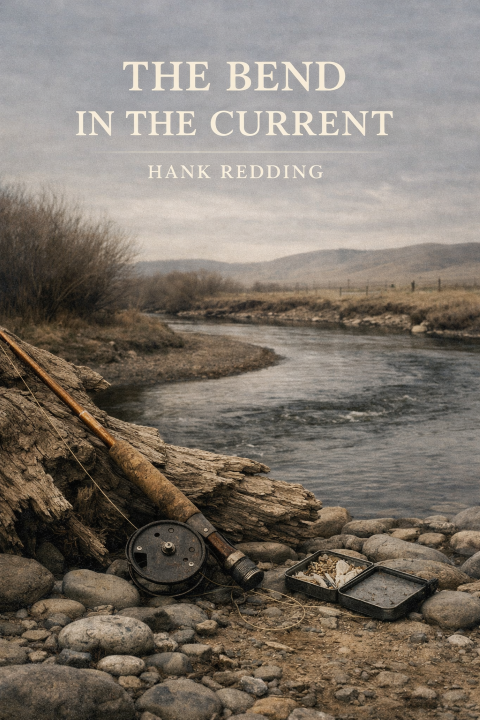
The Bend in the Current
The river was already awake when Thomas Iver Hale reached it.
Light came late into the basin, spilling down the valley in thin, colorless bands that slid across frost-dark grass and stopped short of the water. The bend lay in shadow, the far bank still holding the night. Thomas paused where the trail thinned and stepped out of the willows, listening. Nothing moved except the current, slow and steady where it folded back on itself, deepening into the reach he’d fished for years.
He leaned the rod case against a cottonwood and worked the buckles with his thumbs. The leather was soft from handling, darkened where rain had found it before. Inside, the split-cane rod lay in its cloth sleeve, a mail-order Orvis he’d nursed through ten winters, the sections aligned by habit more than sight. He fit them together without hurry, seating the ferrules until they stopped, not forcing them past that point. He checked the guides, then the tip, running a finger along the cane where a scar showed pale beneath the varnish.
The water was low for this time of year. Clear enough to see the stones on the bottom, rounded and dull as old bone. Thomas waded in below the bend, feeling for the shelf with his left foot before committing weight. The cold reached him immediately, climbing his calves in a way that never changed, no matter how many seasons passed. He stood until the ache settled into something usable.
He stripped line from the reel, false-cast once, twice, then let the fly drift. A simple wet fly, dark-bodied, nothing that would catch a man’s eye in a shop window. He mended the line just enough to let it slip clean through the seam. The fly rode where the current slowed, where the water took its time before moving on.
The strike came deep and deliberate. Not a flash, not a rush. Just weight.
Thomas lifted the rod and felt the fish turn. It stayed down, holding to the bend, using the river the way a thing that had survived winters would. He gave line when it asked for it, took it back when it didn’t. The rod bent into its curve, steady, familiar. His hands did what they knew.
When the fish finally came in, it was heavier than he’d expected. Brown-backed, thick through the middle, the spots along its flank faint and scattered. He held it in the net for a moment, the water moving through its gills, the body quiet in his hands. Then he tipped the net and let it slip free. It rested once against the current and was gone.
Thomas stood there after, rod tip low, watching the place where it had held.
He fished another half hour without result. The light shifted. The far bank brightened. Somewhere upriver, a fence wire sang once and went still. When he reeled in, he did it carefully, guiding the line onto the spool so it wouldn’t cross itself.
He was breaking the rod down when he noticed the boy.
The boy stood on the near bank above the bend, boots planted wide, hands awkward on a cheap rod that looked too light for the water. He hadn’t tried to cast. He was just watching, the way people do when they’re deciding whether to speak.
Thomas slid the rod sections back into their sleeve and tied the cord. He looked once more at the river, then climbed out, water streaming from his trousers. The boy didn’t move.
“You fish here?” the boy asked.
Thomas nodded. He took the rod case and started up the bank.
The boy followed.
Early Days
The boy kept pace a few steps behind him, careful not to crowd. His boots were new enough to shine in places the dust hadn’t reached yet. He carried the rod like something borrowed, gripping it above the cork instead of at it.
“You live up here?” the boy asked.
Thomas didn’t answer right away. He took the narrow trail along the willows, the ground still damp where frost hadn’t burned off. The boy adjusted his stride to match.
“Cabin’s north,” Thomas said finally. “Not far.”
The boy nodded, as if that explained more than it did.
They walked in silence until the river slipped out of view and the valley opened. A low spread of hay ground lay ahead, pale and flattened, the stubble cut short the week before. Fence posts ran along the edge, some leaning, some set straight and new. Thomas paused at one that had shifted during the night. He pressed it with his boot. It held, but only just.
“You fix fence?” the boy asked.
“When it breaks.”
The boy smiled at that, unsure whether it was meant as a joke.
At the cabin, Thomas set the rod case on the bench outside and stepped into the lean-to. Saddles hung from pegs along the wall, oiled dark and stiff with use. Rope was coiled on a nail, one length cut clean where it had been parted with a knife. The boy looked without touching, his eyes moving from tool to tool as if counting them.
Thomas came back out with a hammer and a handful of staples.
“You can help,” he said. “If you want work.”
The boy nodded too fast. “I can work.”
They walked back down toward the fence. Thomas showed him how to set the staple straight, how to strike once and then again, not rushing it, the iron ringing dull against weathered cedar. The boy missed the first two, bent the third. He frowned, pulled it free, tried again. This one seated clean.
They worked without talking. The sun climbed. Somewhere in the basin a hawk cried and went quiet. By the time they finished, the boy’s hands were red and scraped, the shine dulled from his boots.
“You fish every morning?” the boy asked, wiping his hands on his trousers.
“Most.”
The boy hesitated. “I’ve been trying to learn. I can’t make it do what it’s supposed to.”
Thomas picked up the cheap rod and turned it over once. The guides were uneven. The line was too heavy for the water. He handed it back.
“You’re forcing it,” he said. “Let the rod work.”
That was all.
________________________________________
Letting the past surface
That night, Thomas sat on the cabin step with his supper cooling in his hands. Beans and bread. He ate slow, watching the basin darken. Down toward the river, mist gathered where the water slowed, lifting and settling again.
He did not go down to it.
He rarely did at night.
Instead, he took the rope from its peg and checked it, running it through his hands. The cut end was old, stiff with pitch. He tied it to itself, testing the knot until it held his weight. Then he untied it again and hung it back where it had been.
Inside, the cabin held the day’s heat. His boots sat by the door, damp at the seams. On the shelf above the stove lay a folded notice, creased and soft from handling, printed in town and carried out by rail weeks after it mattered. He did not open it. He never did. He only made sure it was still there.
Outside, the river kept moving.
Mid-Season
The boy came back the next morning.
Thomas saw him from the river, standing where the trail dipped, hands shoved into his pockets, waiting to be noticed or dismissed. He didn’t wave. He didn’t call out. He just stood there, shifting his weight when the cold reached him.
Thomas finished his drift and reeled in. When he climbed out, the boy was still there.
“You eat?” Thomas asked.
“Yes,” the boy said. Then, after a pause, “I mean—yes, sir.”
Thomas nodded once and started up the bank.
They ate at the cabin. Coffee thin and bitter, bread torn by hand. The boy chewed too fast at first, then slowed when he saw Thomas wasn’t finished. He watched more than he talked. That pleased Thomas.
After, they worked.
They mended fence where snowmelt had loosened the ground. They hauled a fallen cottonwood out of the draw and cut it down for stove wood. The boy’s swing was wild at first, but he learned to let the axe fall instead of driving it. By noon, his shoulders had settled into the work. By afternoon, he stopped asking what came next.
They went down to the river late, when the light softened and the water lost its glare.
Thomas didn’t say they were fishing.
He took the boy’s rod and stripped line from it, coiling it clean on the bank. He changed the fly without comment, tied it on with a knot the boy didn’t recognize. Then he handed the rod back and stepped into the water.
“Stand there,” he said, pointing.
The boy waded in too deep and had to back out, embarrassed. Thomas didn’t look at him. He cast once, upstream, and let the line settle. The fly drifted into the slower water and disappeared.
“No,” Thomas said quietly. “Watch.”
He cast again. This time the line straightened without crossing itself. The fly rode just beneath the surface, neither rushing nor lagging.
The boy tried to copy it. His line slapped the water, spooking nothing because nothing had been there to spook. Thomas waited. When the boy tried again, it was closer.
They stood like that until the light left the bend. No fish took. That didn’t matter.
On the walk back, the boy finally spoke.
“You ever fish it at night?”
Thomas shook his head.
“River’s louder then,” he said. “Harder to hear what you’re doing.”
The boy thought about that, then nodded, as if it made sense.
________________________________________
Martha Quinn
They met her at the fence line three days later.
She was lifting a gate back onto its hinge when Thomas saw her, the chain looped over her shoulder, one hand braced against the post. The gate was heavier than it looked. She didn’t ask for help.
Thomas set down the sack of staples and took the gate from her without a word. She stepped back, brushed her hands on her skirt, and watched him seat it properly.
“You’ve got water in your north pasture,” she said. “River came up overnight.”
“I’ll see to it,” Thomas said.
She nodded. Her eyes moved to the boy, then back to Thomas.
“He working for you?”
“For now.”
She looked at the boy again. “You eat?”
“Yes, ma’am,” the boy said quickly.
“That’s good,” she said. “You’ll need it.”
She took the chain back from Thomas and swung the gate shut, testing it once before latching it. When she turned to leave, she paused.
“They’re talking again,” she said. “About the basin.”
Thomas didn’t ask who.
“Men come through yesterday,” she went on. “Paper maps. Clean boots.”
She waited, but Thomas said nothing.
“They always come in summer,” she said finally. “When the ground looks easy.”
Then she walked back toward her place, steady, not looking behind her.
The boy watched her go.
“She seems—” he began.
“She knows the land,” Thomas said.
That ended it.
________________________________________
Pressure
Edgar Whitcomb arrived the following week.
He came on a bay gelding that looked too well-fed for the work, coat brushed smooth, tack clean and new. He wore a jacket even though the day had warmed, and his hat brim hadn’t yet learned the shape of his head.
He dismounted carefully and held out his hand.
“Mr. Hale,” he said. “Edgar Whitcomb.”
Thomas shook it. Whitcomb’s grip was firm but brief, like a man who had practiced it.
“I’m speaking with property holders in the basin,” Whitcomb said. “About future use. Improvements.”
Thomas leaned against the fence post and waited.
“Nothing urgent,” Whitcomb went on. “Just discussions. Water rights, primarily. The valley’s well positioned.”
“For what?”
Whitcomb smiled. “For growth.”
The boy stood a little behind Thomas, listening hard.
“I’ll think on it,” Thomas said.
Whitcomb nodded, satisfied. “That’s all I ask.”
He mounted and rode on, the gelding stepping carefully around stones, never once breaking into a trot.
The boy waited until he was gone.
“You going to sell?” he asked.
Thomas looked at the fence line, at the places where wire sagged and held.
“No,” he said.
________________________________________
The River Rises
The storm came late in the season, when the hay was already cut and stacked and the ground had hardened enough to crack.
Rain fell high in the basin, out of sight. By morning the river had changed its voice. Faster. Heavier. Carrying things.
Thomas saw it from the bank and knew it was already too late for the lower pasture.
They saddled without talking.
At Martha Quinn’s place, the water had taken the fence and pushed cattle into the trees. One calf lay on its side near the bend, tangled in brush, bawling weakly. Martha stood at the edge of the water, rope in hand, boots soaked through.
Thomas took the rope and waded in.
The current hit him mid-thigh and leaned into him, harder than he expected. He set his feet and threw the rope wide. It fell short. He tried again.
Behind him, the boy moved without being told, setting his weight where Thomas pointed, bracing the line.
The calf came free. Then the rope went tight, sudden and wrong.
Thomas felt the river take him.
For a moment, there was only pressure—cold, weight, the pull of something that did not care who he was. He went under once, came up coughing, found the rope again by feel.
The boy held. Martha held. Between them, the line stayed whole.
They got him out on the far bank, gasping, laughing once before the sound turned into something else. The boy’s hands shook so badly he had to sit.
Thomas lay back in the grass, rain in his eyes, the river rushing past as it always had.
The fly rod was gone.
________________________________________
After
The storm passed. The river settled back into itself, leaving the banks torn and rearranged.
The boy left a week later.
He stood at the trail head with his pack and the cheap rod slung over his shoulder, the line newly cleaned, the fly changed for one Thomas had shown him how to tie.
“They’re taking names in town,” the boy said. “For the war.”
Thomas nodded.
“You’ll do fine,” he said. It was the closest thing to blessing he knew how to give.
The boy smiled, then turned and walked on.
________________________________________
The Bend
Thomas went back to the Still Reach in the mornings.
He sat where he always had, hands empty, watching the water slow and gather itself before moving on. Once, he thought he saw a rise. He leaned forward, then settled back.
The river did not answer.
It did not refuse him either.
It simply kept going.