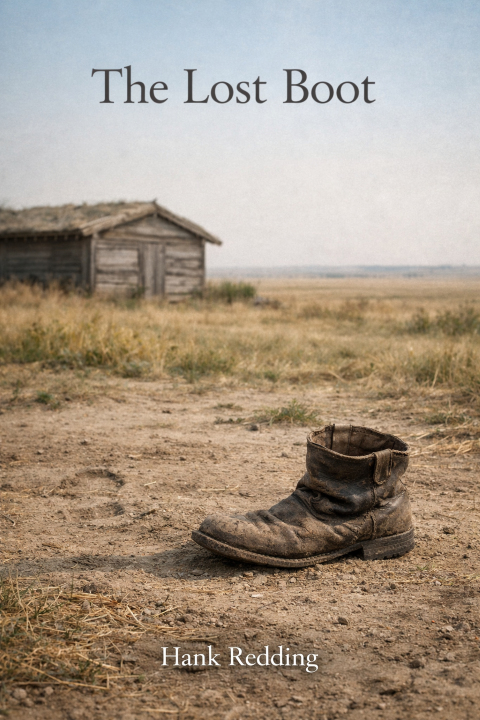
September 1865. Paroled private Caleb Ward arrives in Galveston with a worn amnesty paper and no claim that will hold. Denied land, he works the docks, leaves unpaid, and walks inland along the edge where the ground gives way. When he loses a boot in the marsh, he keeps going.
At the Land Office, Galveston, September 1865
Caleb Ward stood in the doorway of the old customs house, hat in hand, the salt air still thick on his coat from the steamer that had brought him down the coast. Inside, the room smelled of ink, mildew, and wet wool. A clerk—Union man by the blue wool vest, spectacles low on his nose—did not look up from the account book.
“Name?”
“Ward. Caleb Ward.”
“Service?”
“Texas infantry. Paroled June second.”
The clerk’s pen scratched once, twice. “Proof of loyalty oath?”
Caleb reached into his breast pocket, fingers numb from the chill outside. The paper was folded small, edges worn from carrying. He slid it across the scarred oak.
The clerk unfolded it, read, refolded. “That’s the amnesty form. Not the homestead affidavit. You need the full declaration—never bore arms against the United States, never gave aid to enemies. Signed before a notary or magistrate.”
Caleb felt the floor tilt a little. “I signed the parole. That’s what they told us at Shreveport. Said it covered everything.”
“Not for land. Federal requirements. You want the land, you file the affidavit. Cash if you’ve got it. Five years if you don’t.”
Caleb looked at the floorboards. “I got seventeen dollars Confederate scrip and four Yankee greenbacks. That’s it.”
The clerk pushed the amnesty paper back. “Scrip’s worthless. Greenbacks won’t cover the filing fee, let alone the entry. And even if they did—” He glanced up for the first time, eyes flat. “—you carried a musket for the rebellion. The affidavit would be perjury. Next man.”
Caleb did not move. Behind him, a line had formed: a one-armed farmer in patched homespun, a Black family in clean but threadbare clothes, a woman with two children clutching her skirts. The clerk called past him.
“Next.”
Caleb’s hand closed around the amnesty paper. He turned it over once, as if the other side might say something different. Then he stepped back into the doorway, the salt wind hitting his face again. The harbor beyond was gray, ships riding at anchor like ghosts.
He stood there a long minute, hat still in his other hand, the paper creased between thumb and forefinger.
By midmorning he was on the wharf with the others, hands already raw from the hemp ropes, moving cotton bales from wagon to sling under the watch of a man who kept time with a stick against his boot. No names were asked for. Pay was promised at day’s end and not written anywhere. The work went by weight and pace, not fairness—bales rolling, backs bent, sweat cutting tracks through dust. He took the load he was given and passed it on, once, twice, until his shoulders burned and the harbor smell settled into him. When a man dropped out, another stepped forward without comment. Caleb did not look up when the stick tapped again. He kept moving because stopping would have required explanation.
That night he was given a lantern and told where to stand. The watch ran from dark to first light, marked by the harbor clock striking where he could hear it but not see it. His job was to remain. To notice fire, theft, or movement that did not belong. Nothing was written down. No one checked on him. He shifted his weight when his legs cramped and set it back when the clock sounded again. Ships creaked against their lines. The lantern burned low and was trimmed once. When morning came, the man with the stick returned, took the lantern without a word, and nodded toward the shed where pay would be counted later. Caleb stayed where he was until the nod was repeated.
He left before the pay was counted.
Not in haste. Not watched. The shed door stood open, voices inside arguing over weights and short tallies. He walked past it, boots still damp with harbor water, the smell of rope and oil clinging to him. No one called out. No one told him to stop. At the end of the wharf he paused—not because he was uncertain, but because there was no instruction for what came next. Then he stepped down onto the packed sand and kept going, following the line where the tide had turned back on itself, away from the warehouses, away from the clock he could hear but never see.
The shoreline narrowed where the marsh gave way to harder ground, shells crushed into the sand underfoot. He walked with the water to his left and the low brush to his right, keeping to the margin where neither claimed him. The tide had left behind debris—splintered boards, frayed cordage, a broken crate lid stenciled with a mark he did not recognize—and he stepped around it without slowing. His boots filled and drained with each step until he stopped noticing. Behind him, the harbor noises thinned, replaced by the steady sound of water working at itself. He did not look back. He kept to the line that held, moving because it was there, because nothing had told him to stop.
By late afternoon the shoreline thinned into mud and grass, the water breaking into channels that slipped away from each other without pattern. He crossed where he could, boots sinking, pulling free, the ground giving and taking without complaint. There were no tracks that lasted. Birds lifted and settled again. Once he passed the remains of a fire ring—stones scattered, ash pressed flat by rain—and then nothing that suggested anyone had stayed long enough to be remembered. The harbor was gone now, not behind him but erased, the sounds replaced by wind moving through reeds. When he stopped, it was only because the land offered no clear way forward. He stood there, water dark around his ankles, and waited for some sign that did not come.
Night came without a boundary. The light thinned, then failed, leaving the marsh the same shape but harder to judge. He shifted his weight to test the ground before each step, listening for the sound of water moving where it shouldn’t. Insects gathered and dispersed again. His stomach tightened once and then settled into a dull, workable ache. He went on until the mud cooled under his boots and the wind cut through the damp in his coat, and then he stopped—not because he had chosen a place, but because standing and moving had begun to cost the same. He leaned the weight of himself forward, hands on his knees, and waited for the dark to finish doing whatever it was going to do.
By morning the damp had settled into him. His coat was heavy and cold along the seams, the cuffs stiff where salt had dried. He had not slept so much as passed time with his eyes closed, waking whenever his balance shifted or the wind changed. At some point he had crouched lower without deciding to, one knee pressed into the mud, the other foot numb enough that he struck it once with his palm to bring feeling back. When light finally returned, it did not arrive as sunrise but as separation—the water distinct from the grass, the sky no longer the same color as the ground. He straightened slowly. One boot pulled free clean. The other stayed. He worked it loose with both hands, left it behind when it would not come, and stood there in his stocking foot until the cold made the choice for him.
He walked on with the ground uneven beneath him, the bare foot placed carefully, then lifted again before the cold could settle too deep. The stocking darkened quickly, tore at the heel, and then ceased to matter. He learned the pace that kept the ache from sharpening, the way to favor one side without stopping. When the channels narrowed he crossed them; when they widened he followed until they bent back on themselves. The marsh gave him nothing to mark progress—no path, no distance—only the work of staying upright. By the time the sun climbed high enough to dry the reeds, the harbor no longer existed even as an idea. There was only the ground he tested and the next place he put his weight.
The sun held low and steady now, no longer burning but baking, drawing the last moisture from the mud in thin, cracking lines. Caleb moved slower, the bare foot finding purchase where it could, the booted one dragging a shallow furrow that filled behind him with brackish water. Thirst had arrived sometime in the night—not sharp, but constant, a dry pressure behind the eyes that made every breath feel borrowed. He passed a stand of salt cedar, leaves gray-green and brittle, and broke off a small branch, chewed the end until the faint bitterness gave way to nothing. It was not relief. It was occupation.
A heron lifted from the reeds ahead, wings slow and deliberate, and settled again fifty yards on. He followed its line without thinking, stepping where the bird had stepped, the ground firmer there for a stretch. The channels grew shallower, then merged into one sluggish ribbon that curved inland. He crossed it ankle-deep, the water warmer than the air, carrying the faint rot of low tide. On the far side the grass thickened, knee-high, saw-edged, and he waded through it until the blades drew thin red lines across his forearms and the stocking foot. He did not stop to look at them.
By midafternoon the marsh began to give way to something drier—low rises of shell and sand, scattered with scrub oak and prickly pear. The first sign of use was a fence line: three strands of rusted wire strung between crooked cedar posts, sagging in places but still standing. He walked parallel to it for a mile or more, not touching it, not crossing. On the other side cattle grazed in thin clusters, hides dull with dust, tails switching at flies. Once a steer lifted its head and watched him pass, ears forward, then dropped its muzzle again. No rider appeared. No dog barked.
He found water at dusk—a shallow sinkhole ringed with cracked mud, the surface filmed but clear beneath. He knelt, cupped his hands, drank in small sips until the taste of algae coated his tongue, then sat back on his heels and waited to see if his stomach would rebel. It did not. He stayed there until full dark, back against a post that had once held a gate, the wire humming faintly in the wind. The night was cooler here, the stars sharper, no harbor glow to blunt them. He pulled the coat tighter, though it no longer held warmth, and closed his eyes without sleeping.
Morning brought no change in direction. He rose, tested the bare foot—swollen now, the skin split in places—and started again along the fence line. The cattle had drifted farther off during the night. The posts grew farther apart, then stopped altogether where the wire had been rolled up and left in a coil half-buried in sand. Beyond that the ground opened into rolling prairie, grass shorter, wind moving over it in long waves. He kept the old shoreline to his left as best he could, though it was only a memory now, a faint depression in the distance.
Hours later he saw smoke—thin, gray, rising straight in the still air. It came from a low place ahead, a cluster of live oaks shading what looked like a dugout or lean-to, roofed with sod and brush. A horse stood hip-shot near a picket line. A woman moved between the structure and a small fire, her back to him. She wore a sunbonnet and a dress patched at the elbows. A child—small, barefoot—squatted nearby, drawing in the dirt with a stick.
Caleb stopped a hundred yards out. He did not call. He did not wave. He stood until the ache in his legs reminded him he was still upright, then took three steps closer and stopped again. The woman straightened, turned, shaded her eyes. The child looked up too. Neither moved toward him. The horse flicked an ear.
He waited. The wind carried the smell of woodsmoke and something cooking—beans, perhaps, or coffee. His mouth filled with saliva he could not swallow. After a long minute the woman lifted a hand—not in greeting, but in acknowledgment that he existed. Then she turned back to the fire as if he were no more remarkable than the steer that had watched him earlier.
Caleb did not close the distance. He shifted his weight once, felt the bare foot throb in protest, and turned away along the same line he had been following. The smoke stayed at his back, thinning until it was only a faint stain against the sky. He walked on because the ground continued, because the wind still pushed from the gulf, because nothing had yet told him the next place to put his weight was any different from the last.
The prairie stretched wider now, the grass shorter and paler, broken by patches of bare earth that held the heat of the day long after the sun had dropped. Caleb walked until the light turned orange and thin, then kept walking until it turned blue and colder. The bare foot had stopped bleeding sometime after noon; the cuts had crusted over with dirt and dried blood, forming a rough sole that cracked again with every step. He no longer favored it. Favoring required thought, and thought had become expensive.
He passed no more fences. No more cattle. Only the occasional windmill standing alone, blades still, no cattle tank beneath it. Once he saw a line of fence posts that had once held wire but now held nothing, the wood silvered and split by weather. He walked beside them for a while, then veered away when they began to curve in a direction he did not want to follow.
Night arrived without ceremony. He stopped when the ground became too dark to read. He found a shallow depression where the grass grew a little thicker and sat with his back against the wind. The coat was stiff now, the salt and mud forming a second skin. He pulled it tighter across his chest, though it no longer closed. His stomach had gone from aching to quiet, as if it had decided complaint was useless. He closed his eyes and listened to the wind moving over the grass, a sound like someone turning pages in a book no one would ever read.
Morning came gray and damp. Fog had settled during the night, thick enough to soften the horizon, thin enough that he could still see the line of his own footprints behind him, already fading where the grass had straightened. He stood, tested the bare foot—numb but steady—and started again. The fog moved with him, keeping pace, so that the world seemed to shrink to the width of his shoulders. He walked inside it for hours, hearing only his own breathing and the soft crush of grass underfoot.
By midday the fog burned off. The sky opened, hard and clear. The heat returned, not fierce but relentless, drawing sweat that dried instantly on his skin. He passed a single mesquite tree, its branches low and twisted, offering no shade worth the name. He stood beneath it anyway, let the dappled light move across his face, then moved on.
Late in the afternoon he saw the road.
It was not much—a double track of wheel ruts and hoofprints, packed hard by use, running north and south across the prairie like a seam in cloth. He stopped at the edge of it. For the first time since leaving the wharf he felt something like hesitation—not doubt, but recognition. A road meant people. People meant questions, or orders, or the need to explain what he no longer had words for.
He looked south. The ruts disappeared into heat shimmer. He looked north. The same. Nothing moved on either horizon.
He stepped onto the road.
The ground here was firmer, less punishing on the bare foot. He walked down the center of the track, between the ruts, keeping to the high crown where the grass had been worn away. The road carried him without effort, as if it had been waiting. He did not ask where it went. He only followed it because it was there, because it asked nothing of him except to keep placing one foot in front of the other.
The sun dropped behind him, throwing his shadow long and thin ahead. He walked into it. The wind had shifted, coming now from the north, carrying the faint smell of dust and distant woodsmoke. Somewhere ahead—miles, perhaps—a thin line of trees marked a watercourse. He did not hurry toward it. He did not slow. He walked at the same pace he had kept since the marsh, the pace that cost neither more nor less than standing still.
When the light failed again he kept going, trusting the road to hold beneath him. The stars came out, sharp and indifferent. He walked until the cold settled into his bones and the bare foot went entirely numb. Then he stopped—not because he had reached a place, but because continuing would have required more of him than he had left to give.
He sat down in the middle of the road. He leaned forward, elbows on knees, hands loose between them. He waited.
The wind passed over him. The road stayed silent.
The road held through the night, straight as a ruled line drawn across the dark. Caleb walked until the numbness in his bare foot climbed past the ankle, then past the knee, until the leg felt like something borrowed and not fully attached. He did not sit again. Sitting had begun to feel like surrender, and he had not yet decided to surrender.
Dawn came thin and pale, the kind of light that shows every crack in the earth without warming anything. The road curved slightly now, following the contour of a low rise. On the far side of the rise the prairie dropped away into a shallow valley where a creek had cut a narrow green ribbon through the brown. Cottonwoods stood along the banks, leaves already turning the dull yellow of early fall. Smoke rose from among them—not the thin thread of a single fire, but a steady column from a chimney that had been built of river stone and mud.
He stopped at the crest. Below, half a dozen structures: a low house with a sod roof, a lean-to barn, a corral holding three horses and a mule, a smokehouse, a garden patch fenced with split rails. A man in a wool vest and broad hat worked at splitting wood near the house. Two boys—one maybe twelve, the other younger—carried buckets from the creek. A woman in a dark dress hung laundry on a line strung between two posts. The scene moved with the slow certainty of people who had done the same things every morning for years.
Caleb watched for a long time. No one looked up. The distance was enough that he was only a shape against the sky. He could have turned away, followed the road north or south, disappeared back into the grass. Instead he started down the slope, not fast, not slow, boots—one missing—making uneven prints in the dust.
When he reached the bottom the man with the axe paused mid-swing, rested the blade on the chopping block, and looked at him. The boys stopped too, buckets sloshing. The woman straightened from the line, one hand shading her eyes.
Caleb stopped twenty paces out. He did not speak. The man studied him—the torn coat, the missing boot, the face that had not been shaved in weeks, the eyes that gave nothing away.
After a minute the man lifted his chin toward the creek.
“Water’s there. Help yourself.”
Caleb nodded once. He walked past them to the creek bank, knelt, drank in the same small sips he had used at the sinkhole. The water was cold and tasted of limestone and moss. When he finished he stayed on his knees a moment, letting the current pull at his fingers.
The man spoke again, voice carrying without effort.
“You looking for work?”
Caleb rose slowly. He turned. The boys had set their buckets down. The woman had come closer to the house porch, arms folded.
“I can split wood,” Caleb said. The words came out rough, unused. “Or mend fence. Or drive stock. Whatever needs doing.”
The man considered him another long beat.
“Don’t pay much. Meals and a place to sleep in the barn. You eat what we eat. You leave when you want to leave. No questions.”
Caleb looked at the ground between them, then back up.
“That suits.”
The man nodded once, decisive.
“Start with the woodpile then. Axe is sharp. Stack’s low.”
He turned back to his work. The boys picked up their buckets again. The woman went inside without another glance.
Caleb walked to the chopping block. The axe handle was worn smooth, the head nicked but keen. He set a round of oak on the block, lifted the axe, brought it down. The wood split clean, the two halves falling away with a soft thud. He set them aside, placed another round, swung again.
The rhythm came back without thought—lift, swing, split, stack. The ache in his shoulders woke up, then settled into something familiar. The sun climbed. Sweat cut fresh tracks through the dust on his arms. The boys carried water past him twice. Neither spoke. The woman appeared once at the door, watched for a moment, then disappeared again.
By noon the pile was half again as high as it had been. Caleb stopped when the man called him to the house. A tin plate waited on the porch rail: beans, cornbread, a strip of salt pork. A tin cup of coffee, black and steaming.
“Eat,” the man said.
Caleb ate standing. The food was plain and hot. He tasted every bite as though it might be the last. When he finished he set the plate and cup back on the rail.
The man pointed toward the barn.
“Hayloft’s open. Blankets in the tack room. Water barrel’s full. You can wash up there.”
Caleb nodded.
That night he lay in the hayloft on a horse blanket that smelled of saddle soap and old straw. The barn was dark except for a square of moonlight coming through the loft door. Outside, the creek talked to itself. A horse shifted in its stall below. Somewhere far off a coyote yipped once and was answered.
Caleb stared at the rafters. His body hurt in places he had forgotten could hurt. His stomach was full for the first time in days. He was not warm, but he was not cold. He was not alone, but no one had asked his name.
He closed his eyes.
For the first time since the customs house in Galveston, he did not dream of paper, or rope, or lanterns, or marsh mud.
He dreamed of nothing at all.