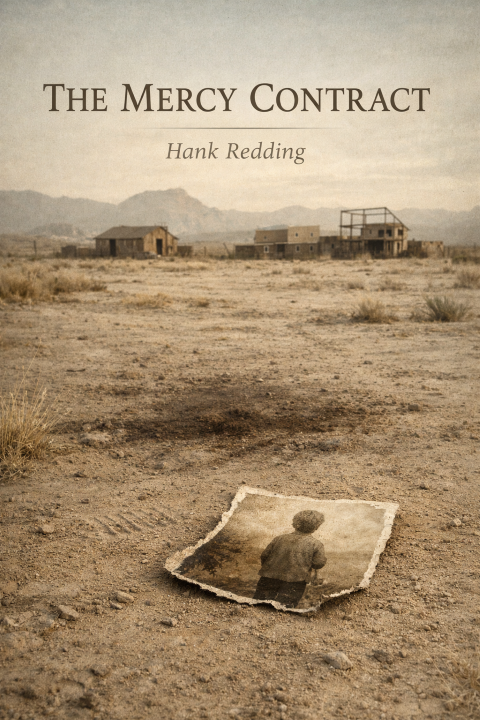
THE MERCY CONTRACT
SETTING:
Providence, Nevada—1881. Once a silver boom town of 4,000 souls, now barely 200 remain. The mines played out in '78. What's left: a half-empty main street, the Criterion saloon, a failing general store, a stable, and the skeletal frame of an opera house that never got finished. The surrounding desert is scattered with abandoned claims and the sun-bleached bones of dreams.
Wind comes through town like it's looking for something.
THE ARRIVAL:
They come on different days in the same week.
Abigail Kern arrives on the Tuesday stage, the only passenger. She's forty-two but looks older—hair still dark but face carved deep by sun and morphine. She wears a threadbare navy dress with a medical bag she won't let anyone touch. The bag contains: bandages, a scalpel, laudanum bottles (three empty, one half-full), a tintype of a young man in Union blue, and a piece of photograph showing a woman's hand.
Moses Pitts rides in Wednesday on a roan mare, leading a packhorse carrying a dead man wrapped in canvas—a bounty he's dragging to Carson City. He's fifty-eight, tall, with white threading his beard. His saddlebag holds the leather journal, a well-maintained Sharps rifle, and his piece of the photograph: a section showing the corner of a wooden structure, burning.
Henry Childress walks in Friday at dawn, having traveled on foot from a ranch thirty miles south. He's lean and sunburned, moves like he's apologizing for taking up space. In his coat pocket: forty-three dollars in wages, a book of Whitman poems he can't read but has memorized from hearing it once, and his photograph piece: the silhouette of a child, standing.
None of them planned to stay. Each came because of the photograph and the word on the back, written in careful script: Remember.
FIRST MOVEMENTS:
Abigail takes a room above the Criterion, pays for a week with money she doesn't have to spare. She starts drinking before noon and offering medical services to anyone who needs them. The first patient is a prostitute named Bells who has a knife wound she won't explain. While stitching, Abigail experiences a moment of spatial vertigo—she suddenly knows there's a loose floorboard in the northwest corner of this room, knows what's hidden there (a pearl earring, a letter from St. Louis). She's never been in this building before.
She checks. The board is loose. The items are there.
Moses stables his horses and takes his bounty to the marshal—a tired drunk named Fogarty who signs the receipt without looking at the body. While waiting, Moses notices seven names carved into the desk wood, old and faded. When he touches them, his fingers go cold. That night in his boarding house room, he dreams in a voice that isn't his: They put the children in the root cellar first.
Henry gets work at the stable mucking stalls. The owner, an old Swede named Petersen, mentions offhand that the town used to be called something else before Providence. "Before the cleansing," he says. "Before things got made right." Henry tries to ask what he means but his stutter locks up completely—his mouth opens and closes like a fish. That night he dreams in Paiute, a language he's never heard, and understands every word.
THE PATTERN EMERGES:
They find each other by accident—or not accident.
Abigail is in the general store when she sees Moses counting out coins for coffee. Something about the way he moves his hands makes her heart race. She approaches him, shows him her photograph piece. His face doesn't change but he reaches into his vest, produces his own.
The edges match.
Henry sees them through the store window, comparing the photographs. He stands outside for twenty minutes, shaking, before he can make himself go in. When he does, he lays his piece on the counter without a word. The three sections don't complete the whole image, but they belong together—you can see it.
They go to Abigail's room and spread the pieces out.
What's visible now: A wooden structure burning. Several figures in the foreground, backs to the camera. A woman's hand in the lower left, reaching upward. The silhouette of a child, standing apart. The landscape is desert, mountains in the background. But the photograph itself is wrong—the image quality suggests it was taken recently, with modern equipment. But the scene depicted looks older. And none of them remember where they got their pieces. They've always had them.
Moses opens his journal and begins writing down what they know. His handwriting is beautiful, practiced. "We need to understand what we're looking at," he says.
"I've been here before," Abigail says quietly. "I know things about this town I shouldn't know."
Henry writes on a piece of paper: I dream in words I never learned.
They decide to investigate together.
THE TOWN'S MEMORY:
Providence doesn't want to remember.
They start asking questions—carefully at first. The responses are strange:
The Criterion's bartender, a man called Sully, gets hostile when Moses asks about the town's history. "We don't talk about before," he says. "Town was founded in '67. Nothing before that."
But the general store has bills of sale from 1865.
The assayer's office has claim records going back to 1864.
When Abigail asks the prostitute Bells about the old-timers, about anyone who might remember the early days, Bells looks frightened. "They're dying," she says. "Haven't you noticed? All the old men are dying."
She's right.
Since the three arrived: Thomas Garrett, former mine supervisor, found in his cabin with his hands folded over his heart. Natural causes, the marshal said. Samuel Dutch, retired prospector, discovered at the base of an old shaft, positioned the same way. Accidental fall. Clay Herschel, town founder, died in his sleep at the boarding house—hands over heart.
Moses examines the bodies before burial. Each man has the same mark on his chest: a small scar, old, circular. Like a brand that faded. He sketches them in his journal.
Henry, because he's invisible in the way young quiet people are, hears things. The Swede Petersen talking to another old man late at night: "...should've stayed buried...coming back for accounting..." A woman at the general store to her daughter: "...don't go near the burned ground north of town..."
The burned ground. They ride out to find it.
THE SITE:
Five miles north, there's a depression in the earth where nothing grows. The ground is still stained dark in places. You can see where structures stood—post holes, the remains of fire pits, fragments of pottery. A Paiute camp, clearly. And it was burned deliberately, thoroughly.
Abigail dismounts and immediately vomits. She can smell it—smoke, burning flesh. But the fire was fifteen years ago.
Moses walks the perimeter and finds spent cartridge casings. Seven different positions where shooters stood. He collects them, hands shaking.
Henry stands in the center of the burned ground and begins to weep. He doesn't know why. The tears just come and won't stop.
When they return to town, Petersen is dead. Hands over his heart.
THE INVESTIGATION DEEPENS:
They break into the marshal's office at night. Fogarty is passed out drunk, won't wake until morning.
The old records are kept in a back room, mostly mice-eaten and water-damaged. But Moses finds something: a report from November 1866, written by a territorial ranger. It describes responding to reports of "Indian trouble" near a settlement called Bittercreek (which would become Providence). When he arrived, he found "a Paiute encampment destroyed, approximately 40-50 dead, evidence of systematic massacre."
The report lists seven men he interviewed as potential witnesses. The seven names from the desk. All claim they were prospecting elsewhere when it happened. No charges filed. Case closed.
But there's a notation at the bottom, added later in different ink: One child unaccounted for.
Abigail finds a ledger from 1867—the year Providence was officially founded. Seven men purchased all the land claims. The same seven names. They built the town on top of the massacre site, literally. The main street runs right through where the Paiute camp stood.
Henry finds photographs in a box. Town pictures from the early days—founding celebrations, mine openings. In several of them, in the background, there's a Paiute child. Maybe ten years old. Standing at the edge of the frame, watching. Just watching.
In one photo, the child is standing between two white adults. A man and a woman. The woman is wearing a dark dress. The man is tall, bearded. Henry's hands go numb. He knows these people. He knows them.
THE UNRAVELING:
That night, each of them experiences something that breaks the membrane between past and present.
Abigail dreams she's in a root cellar, dark, with children crying around her. She's trying to keep them quiet. She whispers in Paiute: Ssh, ssh, they'll hear. Above, boots walk across wooden planks. Then gunfire. Screaming. She's trying to cover the children with her body when the cellar door rips open and light pours in—
She wakes up screaming. There are dirt stains on her nightgown. Under her fingernails.
Moses dreams he's standing in a circle of six other men. They're discussing what to do about "the situation." One man says: "Can't have them here. They'll drive off trade." Another: "It's them or us." He wants to object—he can feel himself wanting to speak against it—but he can't make his mouth work. He just stands there. Silent. Complicit. One of the men hands him a rifle—
He wakes with his hands clenched like he's holding a weapon. On his palms: powder burns that weren't there before.
Henry doesn't dream. He walks. Sleepwalking, he leaves the stable and walks five miles in the dark to the burned ground. When he wakes at dawn, he's standing in the center of the ash-stain, and his hands are positioned over his heart. Waiting.
THE CONVERGENCE:
They meet at breakfast, haggard and frightened. Compare experiences. Something is happening to them—they're either remembering things they did, or remembering things that were done to them, or both. The boundaries are dissolving.
Moses suggests they might be possessed. That the spirits of the dead are using them to exact revenge on the killers.
Abigail suggests they might have been drugged. That someone is playing an elaborate trick, inducing false memories.
Henry writes: What if we were there?
They sit with that.
"We'd be too young," Abigail says. "It was 1866. I'd have been—" She stops. She can't remember how old she'd have been. She knows her birthday is March 12, 1839. She's said it a thousand times. But suddenly she can't feel the truth of it.
Moses checks his journal. He's written his life story in it over the years—his birth in Maryland, 1823. His wife Rebecca. His daughters Ruth and Hannah, dead in '71. He knows this. But when he tries to picture Rebecca's face, he sees someone else. A Paiute woman with careful hands, braiding her daughter's hair.
Henry has no identification. He's never needed it. He doesn't know his birthday. He was told he was found wandering as a child, adopted by a rancher. He's always assumed he was white. But his skin is dark from sun, his hair black and straight. He's never questioned it.
Until now.
THE DEATHS ACCELERATE:
Two more old-timers die that night. Hands over hearts.
Only one of the original seven remains: Jacob Ware, bedridden in a house at the edge of town, dying of lung disease. They go to him.
Ware is maybe seventy, wasted to nothing. When he sees the three of them enter his room, his eyes go wide. "No," he whispers. "No, you can't be here. You're dead."
"Who are we?" Abigail demands.
"You're dead. We—we did what we had to. You were—it was war, it was—"
"Who are we?" Moses asks again, gentle but firm.
Ware starts crying. "The woman who hid the children. The man who wouldn't shoot. The child who watched. You're them. But you died. I saw you die."
"What are our names?" Abigail's voice breaks.
But Ware is seizing, thrashing. His hands clutch his chest. He's trying to say something but can't get it out. His eyes lock on Henry. "You," he gasps. "You were supposed to forget. We raised you to forget. We gave you mercy—"
He dies. Hands over his heart.
The last of the seven.
THE PHOTOGRAPH COMPLETES:
They return to Abigail's room in silence. The three pieces of the photograph are still on the table.
Except now there's a fourth piece.
It's lying between the others, perfectly positioned. None of them put it there.
When they arrange all four pieces together, the image is complete:
The burning camp. Seven men in the foreground, backs to the camera, rifles in hand. In the middle distance, a woman running with children toward a root cellar. To the left, a man on his knees, hands up, pleading. And in the very center, small and clear: a child, standing alone, watching everything. The child is holding something—
A camera.
The child took the photograph.
Of their own murder.
THE GRAVE:
They ride out at midnight, following a compulsion none of them can explain. North of the burned ground, there's a small rise. A single tree, dead. Beneath it: three graves.
The markers are stone, crude but permanent. The names:
NAALNISH (SHE WHO HEALS) Died November 15, 1866
HASTIIN (THE MAN WHO SPEAKS) Died November 15, 1866
ASHKII (THE CHILD) Murdered November 15, 1866
Beneath these names, someone has carved three more, recent, the stone still white:
ABIGAIL KERN MOSES PITTS HENRY CHILDRESS
No dates.
At the base of the stone, pressed into the rock itself, is a child's handprint. It looks wet. Fresh. But the stone is ancient.
Henry kneels and places his hand over it.
Perfect fit.
THE QUESTION:
They sit by the graves until dawn. Not speaking. What is there to say?
Are they ghosts who forgot they were dead? Are they reincarnations, drawn back to finish something? Are they the killers, cursed to experience what they did? Are they innocent people possessed by the vengeful dead?
Moses finally speaks: "If we're them—the ones who died—did we kill those men?"
"The old-timers died of fear," Abigail says. "Their own guilt killed them. We didn't touch them."
"But we came here for it," Moses says. "We came to make them remember."
"Did we?" Abigail asks. "Or were we sent?"
Henry writes in the dirt with a stick: WHO SENT THE PHOTOGRAPHS?
They have no answer.
The sun rises. Providence looks small and temporary from up here, like it could blow away. Maybe it will. Maybe it was always going to.
THE DEPARTURE:
They don't discuss it. They just know.
Abigail packs her medical bag. She pours the last of her laudanum on the ground. She doesn't need it anymore. She's not in pain. She hasn't been in pain since she arrived. She realizes this now. The morphine hunger—gone. She died fifteen years ago. Dead people don't feel pain.
Or maybe she didn't die. Maybe she's just a woman who came to a town and witnessed something true about guilt and memory. Maybe that's all.
She can't know.
Moses saddles his horse. He burns his journal, every page. All those pressed flowers, all those memories of Rebecca and Ruth and Hannah. Were they real? Or were they a story he told himself to survive being someone else?
He can't know.
Henry saddles Petersen's spare horse—he figures the old man owes him that much. He thinks about the rancher who raised him, the man who told him he was found wandering. Was that man one of the seven? Was Henry the child they "showed mercy" by raising white, by teaching to forget?
He can't know.
They meet on the main street at noon. The photograph pieces are gone—dissolved, burned, never existed. They can't remember.
"Where will you go?" Abigail asks.
Moses says, "East. I think. Or maybe I've always been going east."
Henry writes: ANYWHERE
"Will we see each other again?" Abigail asks.
"We might not be real," Moses says quietly. "We might fade when we leave. We might wake up and be someone else. We might have always been someone else."
"I feel real," Abigail says.
"So did they," Moses says. "The people in the graves."
Henry mounts his horse. He looks at the two of them and his mouth works, trying. Finally, after all this time, words come:
"R-r-remember."
Just that one word. Then he rides south.
Moses tips his hat to Abigail and rides east, leading his packhorse with no body on it.
Abigail stands alone on the street. She looks down at her hands. They're there. Solid. Real.
Or are they?
She rides west.
Behind her, Providence settles back into its slow dying. The Criterion stays open. Bells keeps working. Marshal Fogarty keeps drinking. The wind keeps searching.
In fifteen years, there will be nothing left of the town. Not even ruins. Just empty desert and the faint stain in the earth where nothing grows.
And somewhere, traveling in three different directions, three people ride on. They might be ghosts. They might be killers. They might be victims. They might be strangers who stumbled into someone else's story.
They'll never know.
The photograph is gone.
But the child's handprint remains in the stone, and will remain, long after everything else is dust.
Remember.