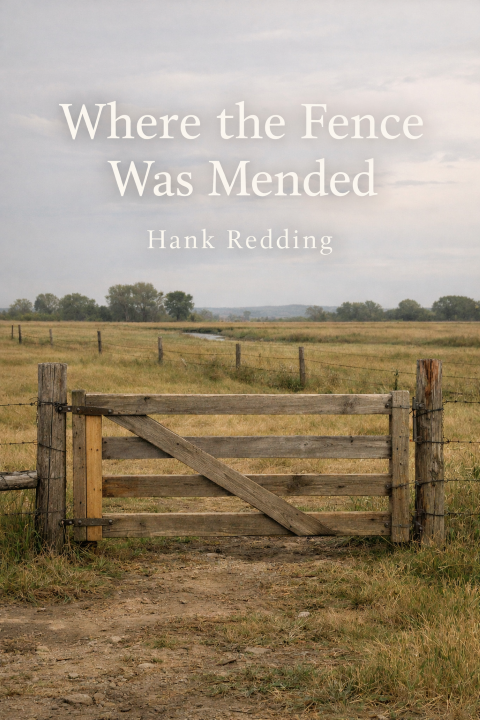
Chapter 1 — Arrival Without Announcement
Edgar Ruhl came into Belden at midmorning, when the light had finished deciding what kind of day it would be. The road sloped down from the west and flattened just before town, the ruts pressed hard by years of wagons that had arrived with purpose and left without it. Edgar walked the last mile, his coat folded over his arm, his tools wrapped in canvas and tied with twine he’d reused more times than he could count.
Belden did not look up.
A man sat on a crate outside the feed store, repairing a harness strap. He did not pause. Somewhere behind the buildings, water moved through the ditch in a steady, ordinary sound—neither hurried nor weak. Edgar listened to it without stopping, then continued on.
The boardinghouse stood one street off the main stretch, its paint worn thin enough to show the wood beneath. One shutter hung crooked, not broken, just tired. Edgar noticed it the way he noticed everything else: without judgment, without hurry.
Inside, the air smelled of boiled coffee and floor soap. A woman stood at the counter, writing in a narrow ledger with a pencil worn down to its metal band. She did not ask who he was.
“You looking for a room?” she said, still writing.
“Yes,” Edgar said.
She finished the line she was on, set the pencil aside, and looked at him. Her hair was pinned back neatly. Her dress was clean and plain. She held herself the way someone does who has already decided how things will be done.
“I’m Norene Ickes,” she said. “Meals are at six and at noon. Supper’s quiet. You pay weekly.”
Edgar nodded. “That’s fine.”
She slid a key across the counter. “Back room. Second floor. Stairs are narrow.”
“I’ll mind them,” Edgar said.
She watched him take the key, then the bundle under his arm. Her eyes paused there, not curious, just accounting.
“You work?” she asked.
“Yes.”
She nodded once, as if that settled it. “There’s coffee left. It’s still warm.”
Edgar thanked her and took the cup she offered. It was strong. He drank it standing, then carried his things upstairs. The room was small, with a narrow bed and a window that looked out over the yard. From there he could see the ditch, running behind the buildings in a shallow cut, its banks reinforced with boards that had been set years ago and never properly aligned.
One section leaned. Not badly. Enough.
He set his bundle down and sat on the bed without removing his boots. Outside, a gate swung once in the breeze and struck its post with a dull, unfinished sound. Edgar listened to it for a moment, then stood.
He went back downstairs.
Norene Ickes looked up as he passed. “You find everything?”
“Yes,” he said. “There’s a gate in the yard. Hinge is loose.”
She studied him for a second, then returned to her work. “It’s been that way a while.”
“I can fix it,” Edgar said. Not as an offer. Just as a fact.
She nodded. “All right.”
Edgar stepped back outside. He knelt by the gate, set his tools down, and went to work. He did not rush. He did not straighten the gate more than it needed. He tightened what was loose and left the rest alone.
When he finished, the gate closed without sound.
Edgar stood for a moment longer, listening to the water behind the buildings. Then he gathered his tools and went back inside, already part of the day.
Chapter 2 — Work Finds Him
By the third day, Edgar Ruhl had stopped being new.
No one remarked on it. It happened the way things do in Belden—by omission. He walked the streets in the mornings with his tools under his arm, and no one asked where he was headed. He worked until midday, and when he sat on the edge of the ditch to eat, no one stared long enough to count it as interest.
The fence behind the livery was the first thing he took on that wasn’t his.
It leaned inward, not enough to fail, just enough to be wrong. One post had settled lower than the rest, the soil washed thin around its base. Edgar knelt, pressed the earth with his thumb, and felt how it gave. He fetched a spade from the shed without asking. The man inside watched him do it and said nothing.
Edgar reset the post. He packed the dirt back tight, tamped it down with the heel of his boot, and replaced a nail that had bent itself halfway out of the rail. When he finished, the fence stood straighter than it had in years—but not so straight it looked new.
The man from the livery came out then. He was older, with a hat that had lost its shape and not been replaced.
“How much?” the man asked.
Edgar named a figure that matched the work and no more.
The man nodded, went inside, and returned with the money folded once, lengthwise. He handed it over without counting it in front of him. Edgar did the same.
That afternoon, Burton Keel found him at the edge of the south pasture, studying a stretch of wire that had been repaired too many times to remember the original break.
“You the one fixed Mallory’s fence?” Burton said.
Edgar looked up. Burton Keel stood with his hands in his coat pockets, boots planted wide as if the ground needed to be told where to stay.
“Yes,” Edgar said.
Burton nodded. “Didn’t rush it.”
“No,” Edgar said.
They stood a moment longer. Wind moved through the dry grass, laying it down and letting it rise again. Burton followed Edgar’s gaze along the wire line.
“That fence still holds,” Burton said.
“Yes,” Edgar said. “For now.”
Burton Keel gave a sound that wasn’t agreement or dismissal. He turned his head slightly, looking out toward the fields that sloped down toward Cold Alder Run. Water moved there, slow and steady, catching the light.
“You work ditches?” Burton asked.
“I have,” Edgar said.
Burton nodded once. “Might have something for you.”
He didn’t say when. He didn’t say how much. He turned and walked away as if the conversation had finished itself.
Later, Edgar repaired a porch step on the east side of town. The woman who lived there watched him from the doorway with her arms folded tight against the cold.
“You don’t need to replace the whole board,” she said.
“I won’t,” Edgar said.
When he finished, the step no longer dipped in the middle. It didn’t look improved. It looked correct.
She pressed a coin into his hand anyway, smaller than the work deserved. Edgar took it without comment.
That evening, he ate supper at Norene Ickes’ table with three other men who spoke little and said nothing to him directly. When the plates were cleared, he rose and carried his to the sink without being told.
Norene noticed. She did not thank him.
Afterward, Edgar stepped outside. The light was leaving the yard in long, careful strips, settling into the low places first. The gate he’d fixed remained still. The hinge held.
He listened again to the water behind the buildings. It ran as it had before, carrying what it carried, unaware of who depended on it.
Edgar stood there until the light was gone, then went back inside.
Chapter 3 — Norene’s House
Norene Ickes kept the boardinghouse the way she kept everything else: clean enough to trust, plain enough not to invite comment. Floors were scrubbed twice a week. Windows were washed when the light made it obvious they needed it. Nothing was fixed early, and nothing was left broken once it began to interfere.
Edgar noticed these things without remark.
On the fourth morning, a stair near the back wall gave slightly under his weight. Not enough to complain. Enough to remember. He ate his breakfast, rinsed his plate, and returned with his tools before the house had fully emptied.
Norene watched from the kitchen doorway as he knelt and tested the step with his hand.
“It’s held that way for years,” she said.
“Yes,” Edgar said. He loosened the nails carefully, lifting the board without splitting it. The support beneath had shifted, the wood pressed thin where weight had learned its habits.
“You don’t need to do that,” she said. Not sharply. Just as a statement.
“I know,” Edgar said.
He reset the support, added a small wedge cut from scrap he’d carried without realizing he would need it, and seated the board again. When he stood, the stair no longer dipped. It did not feel improved. It felt right.
Norene stepped closer and tested it herself. She did not smile. She did not thank him.
She went back to the kitchen and returned with a cup of coffee, set it on the table beside him.
“It’s fresh,” she said.
Edgar drank it standing. When he finished, he rinsed the cup and placed it upside down to dry.
That evening, the boardinghouse filled earlier than usual. A traveling salesman had taken the front room, and two men from up the valley arrived late and ate without speaking much beyond what was required. The sound of cutlery filled the space between them, steady and unremarkable.
Edgar sat where he always did, back to the wall, hands folded loosely when he was done. Norene moved through the room with practiced economy, collecting plates, refilling water without asking.
When the others rose, Edgar remained seated.
“You don’t have to wait,” Norene said, passing behind him.
“I know,” Edgar said.
She nodded and continued on.
Later, when the house had quieted and the lamps were turned low, Edgar worked at the small table near the window, sharpening a blade he’d nicked earlier in the day. He worked slowly, drawing the metal across the stone in measured strokes, listening to the sound it made.
Norene sat across from him with her accounts, the pencil moving in short, careful lines. Neither of them spoke.
After a while, she closed the book and looked up.
“You don’t ask questions,” she said.
Edgar kept his eyes on the blade. “No.”
She considered that. “Most men do.”
“Yes,” Edgar said.
Outside, a breeze moved through the yard, stirring dust that settled again almost immediately. The gate did not move. The hinge held.
“You staying long?” Norene asked.
“I don’t know,” Edgar said. He finished the blade, wiped it clean, and set it aside. “I haven’t had reason to leave.”
Norene nodded once. That was enough.
She rose, extinguished one of the lamps, and left the room. Edgar remained where he was, listening to the house settle, the boards cooling, the water running behind the buildings in its narrow cut.
The stair did not creak when he went up later.
That night, he slept without waking.
Chapter 4 — Royden Wants Out
Royden Fisk kept his eyes on the road more than the town. Edgar noticed it the first time he saw him, standing near the depot with his hands shoved deep in his coat pockets, weight shifting as if the ground beneath Belden were already unreliable.
Royden was seventeen, or near enough to it that the difference no longer mattered. His boots were worn thin at the toes, and his hat sat wrong on his head, not from fashion but impatience. He watched the rails as if they might move without warning.
Edgar was repairing a loose board on the depot platform when Royden spoke.
“You get here on foot?” Royden asked.
“Yes,” Edgar said.
Royden nodded, as though that confirmed something he’d suspected. “Most people don’t.”
Edgar set the board back in place and drove the nail home. He did not answer right away.
“You ever take the eastbound?” Royden asked.
“I have,” Edgar said.
Royden waited for more. When none came, he frowned slightly. “They say it doesn’t stop long in Belden. Barely slows.”
“That’s true,” Edgar said.
Royden kicked at a stone near the rail. “I don’t plan on staying.”
Edgar stood and brushed the dust from his hands. “All right.”
Royden looked at him, expecting objection, encouragement, something that would give the words shape. When Edgar gave him none, Royden’s expression tightened.
“You don’t think that’s smart?” Royden said.
“I don’t think much about it,” Edgar said.
That irritated Royden more than disapproval would have. “You don’t care either way?”
Edgar considered him for a moment. “It’s your leaving,” he said. “You’ll know when it’s time.”
Royden scoffed quietly. “You talk like someone who’s already done it.”
Edgar didn’t answer. He picked up his tools and stepped off the platform.
Royden watched him go, jaw set, as if the conversation had ended without permission.
That afternoon, Edgar worked along the ditch behind the buildings, clearing debris that had collected where the water narrowed. He noticed Royden again near dusk, this time sitting on a fence rail, swinging one leg, watching him without pretense.
“You fixing that?” Royden asked.
“Yes,” Edgar said.
“Why?” Royden said. “It’s not broken.”
Edgar reached into the water and lifted out a length of driftwood lodged against the bank. When he pulled it free, the water moved more easily.
“It will be,” Edgar said.
Royden frowned. “Everything around here’s always about to be.”
“Yes,” Edgar said.
Royden was quiet for a moment. Then, softer, “You ever regret staying anywhere?”
Edgar straightened slowly. He wiped his hands on his trousers.
“No,” he said. “I’ve regretted leaving.”
Royden looked away, back toward the rails. The light was thinning now, settling into the low places first, the ditch catching the last of it.
“Train’s due tomorrow,” Royden said. “Morning.”
Edgar nodded. “I know.”
Royden waited, then realized Edgar would not ask if he was getting on it. That seemed to unsettle him most of all.
When Royden finally climbed down from the fence and walked off, Edgar returned to the water. He worked until the sound of it evened out again, then gathered his tools and headed back toward town.
Behind him, the rails lay still.
Chapter 5 — The Ditch
The ditch had been cut before Belden learned to speak for itself.
It ran behind the buildings in a shallow line that followed the land’s least resistance, fed by Cold Alder Run and guided by boards that had been set by men who were gone now. Some sections had been replaced. Most had not. The water moved because it always had.
Edgar walked its length early, before the town had finished waking. He carried no tools at first—just his hands, his eyes, and the patience to look without fixing.
Near the south pasture, the bank had begun to soften. Not enough to fail. Enough to remember. The boards there had shifted out of alignment, their ends no longer meeting cleanly. Soil had washed thin beneath them, leaving a hollow you could feel if you pressed your fingers in deep enough.
Edgar knelt and did just that.
The earth gave more easily than it should have.
He stood and followed the line farther down, checking each joint, each brace. Most held. One did not. It leaned away from the current instead of into it, the way things did when they were waiting to be pushed.
Burton Keel found him there an hour later.
“You measuring it?” Burton asked.
Edgar straightened. “No.”
Burton stepped closer, boots sinking slightly into the damp ground. He followed Edgar’s gaze to the weak section.
“That spot’s always been that way,” Burton said.
“Yes,” Edgar said.
“It’s held,” Burton said.
“So far,” Edgar said.
Burton folded his arms and looked up the line, then down again. The water moved steadily, untroubled by their concern.
“Storm’s coming,” Burton said. “They say.”
“Yes,” Edgar said.
Burton gave a short nod. “They always do.”
Edgar hesitated. Not long. Just enough to count.
“It won’t hold much more water,” he said. “Not without shoring.”
Burton was quiet. He looked out toward the fields, toward the pasture fence Edgar had straightened weeks before. It still stood true, lines clean against the grass.
“Too late in the season,” Burton said. “Men are tied up. Weather will pass.”
“It might,” Edgar said.
Burton met his eyes. “And if it doesn’t?”
Edgar did not answer right away. When he did, it was plain. “We lose ground. Maybe stock.”
Burton exhaled through his nose, not in frustration, but calculation. “We’ve lost ground before.”
“Yes,” Edgar said.
They stood there, the water moving between them, the sound of it steady enough to argue against worry.
“I’ll put a man on it if it worsens,” Burton said at last.
Edgar nodded. “All right.”
Burton turned to go, then paused. “You fixing anything today?”
“Yes,” Edgar said.
Burton nodded again. “Good.”
When he was gone, Edgar stayed. He fetched his tools and began reinforcing what he could reach alone—resetting one brace, tightening another, adding stone where soil had thinned. He did not pretend it was enough. He worked anyway.
By midday, the clouds had begun to gather, not dramatic, just persistent. The light dulled. The water lifted slightly in the ditch, darkening as it carried more with it.
Royden Fisk came by near afternoon, hands in his pockets again.
“You hear about the storm?” Royden asked.
“Yes,” Edgar said.
Royden glanced at the ditch. “That thing safe?”
“For now,” Edgar said.
Royden frowned. “You always say that.”
Edgar smiled faintly. It did not last. “For now is sometimes all there is.”
Royden kicked at the dirt. “Train’s still coming tomorrow.”
Edgar nodded. “Yes.”
Royden waited for something else. It did not arrive.
That evening, the first rain came down slow and steady, soaking in instead of running off. Edgar stood in the yard behind the boardinghouse and listened to it strike the ground. Norene Ickes watched from the doorway.
“You expect trouble?” she asked.
“I expect water,” Edgar said.
She studied his face, then nodded once. “Supper’s hot.”
Edgar came inside. He ate. He dried his boots by the stove. Outside, the rain continued, patient and unremarkable.
The ditch carried it.
For now.
Chapter 6 — Weather Out of Season
The rain stopped sometime before dawn, not cleanly, but in the way of things that had not finished what they came to do. The ground held the damp. The air carried it. When Edgar stepped outside, the smell of wet earth lingered longer than it should have.
Belden took that as a good sign.
By midmorning the clouds had thinned, breaking into high, pale strips that let the light through without warming anything. Men stood outside the stores and spoke of how the storm had passed. Someone said the hills would take the rest. Someone else said the ditch had always been enough.
Edgar listened and did not argue.
He spent the morning gathering what he could without drawing notice—old boards stacked behind the livery, a length of wire no longer fit for fencing, stones pulled from the edge of the run where the bank had begun to scallop away. He set them aside near the weak section of the ditch, arranging them neatly, as if order alone might persuade them to hold.
Royden Fisk watched him from a distance.
“You expecting another one?” Royden asked when he came closer.
“Yes,” Edgar said.
“They said it cleared,” Royden said.
Edgar lifted a board, tested its weight, and leaned it back against the bank. “It didn’t.”
Royden frowned. “Sky looks fine.”
“The hills don’t,” Edgar said.
Royden followed his gaze upslope, where the land rose into dark folds that caught weather even when the town did not. Snow still clung there in patches that hadn’t learned the season had changed.
“You working tonight?” Royden asked.
“Yes,” Edgar said.
Royden hesitated. “I can help.”
Edgar looked at him then, not assessing strength, only steadiness. “You know how to stack stone?”
Royden nodded. “I can learn.”
“That’s enough,” Edgar said.
They worked through the afternoon, reinforcing where they could, knowing it was partial, knowing partial was sometimes the difference between loss and damage. The water in the ditch darkened again, lifting against the boards with a quiet insistence that did not announce itself.
Burton Keel rode out near evening, reins loose in his hands.
“Looks like you’re expecting trouble,” he said.
Edgar wiped his hands. “I am.”
Burton surveyed the work, the stacked stone, the braced boards. He did not comment on the effort.
“Storm line’s slow,” Burton said. “Might miss us.”
“It might,” Edgar said.
Burton’s jaw tightened slightly. “And if it doesn’t?”
Edgar did not soften it. “Then we’ll know tonight.”
Burton nodded once. “I’ll come back after supper.”
When he rode off, the wind began to shift. Not stronger—different. It came from the hills now, carrying cold with it that belonged to higher ground.
At the boardinghouse, Norene Ickes noticed Edgar’s preparations without asking. She wrapped food in cloth and set it aside.
“You won’t be at table,” she said.
“No,” Edgar said.
She considered that. “I’ll leave the lamp on.”
By the time the light began to fade, the clouds had thickened again, lowering themselves as if the sky were trying to remember where it belonged. The first drops came heavier this time, spaced just far enough apart to make each one felt.
Royden arrived at the ditch with his sleeves rolled and his jaw set. He did not speak.
They worked until the ground softened beneath their boots, until the water began to press with intent instead of habit. Somewhere up the valley, thunder rolled—not sharp, but long, as if the sound had to travel a distance to matter.
Burton Keel came on foot, coat pulled tight, rain darkening the brim of his hat.
“Let’s hold what we can,” he said.
They did not answer. They already were.
As night closed in, the water rose another inch, then another. The ditch took it. The boards flexed. Stones shifted.
Edgar felt the line between enough and not enough narrow beneath his hands.
The storm had not arrived all at once.
It was coming piece by piece.
Chapter 7 — Nightfall
Dark did not come cleanly. It slid in between the rain and the wind, filling the spaces the light abandoned. The ditch was louder now, no longer steady, the water striking the boards with a hollow sound that carried through the ground before it reached the ear.
Edgar stood knee-deep in mud, hands braced against a post he’d set earlier that afternoon. It held—for the moment—but the pressure against it had changed. Water had weight now. Intent.
Royden worked a few yards downstream, stacking stone where Edgar pointed, his movements quick but no longer careless. He slipped once, caught himself, and did not laugh about it.
“Keep them tight,” Edgar said.
“I am,” Royden said, breath already short.
Burton Keel moved along the line, lantern held low, the light cutting a narrow path through the rain. He said little. When he did, it was to tell them where the water was beginning to cheat, finding places to argue its way through.
“It’s rising fast,” Burton said.
“Yes,” Edgar said.
Thunder rolled again, closer this time. Not sharp. Heavy. The kind that stayed.
The first board failed without warning. Not a crack—just a sound like a breath leaving something too tired to keep standing. Water surged through the gap, dark and cold, tearing soil loose as it went.
Edgar stepped in without hesitation, shoving the board back into place with his shoulder while Royden scrambled to brace it. The water soaked them instantly, driving through cloth and skin alike.
“Stone,” Edgar said.
Royden shoved a handful in where he could, fingers numb, knuckles scraped raw. The board held again—but just.
Burton knelt beside them, pressing his weight in where Edgar couldn’t reach. “We can lose this section,” he said. “Save the lower line.”
Edgar met his eyes. “If we lose this, we lose more than that.”
Burton nodded once. “Then we hold it.”
The wind shifted, driving rain sideways now. The lantern guttered. Burton raised it higher, then lowered it again when the glare made it harder to see.
Time thinned. Minutes stretched. Each surge of water felt like the one that might decide things.
Royden’s hands shook as he worked. “It’s not stopping,” he said.
“No,” Edgar said. “But it will slow.”
“How do you know?” Royden said.
“I don’t,” Edgar said. “But it always does.”
Another surge came, higher than the last. The post Edgar braced shuddered. He felt it move—not much, but enough to know the earth beneath it was no longer certain.
“Burton,” Edgar said. “Step back.”
Burton did not.
Instead, he shifted his weight, planting his boots deeper into the mud, pressing himself against the failing section as if his body were one more brace.
“I’m not stepping back,” Burton said. He did not raise his voice. He did not need to.
The bank gave way beneath him.
It happened fast. A slip, a loss of footing, Burton’s shoulder striking the edge of the ditch hard enough to knock the breath from him before the water could. His head struck the timber with a sound Edgar would remember later.
The lantern went dark.
“Burton!” Royden shouted.
Edgar was already there, hands under Burton’s shoulders, hauling him clear of the water. Burton’s body was heavy in a way that told Edgar what he needed to know before he confirmed it.
Burton did not breathe.
Rain fell on his face, washing the mud from it, revealing nothing that could be argued with.
Royden stood frozen, water running off his hair, his mouth opening and closing without sound.
“We can’t—” Royden said.
Edgar shook his head once. “We have to finish.”
Royden stared at him. “He’s—”
“I know,” Edgar said. His voice was steady. It cost him something. “If we don’t finish, this spreads.”
Another surge hit the line. The board Edgar had braced earlier gave a fraction more.
Edgar set Burton’s body gently on higher ground, turning him away from the water. He took the lantern from where it lay, struck it back to life with shaking hands, and handed it to Royden.
“Hold the light,” Edgar said. “Right here.”
Royden swallowed hard. He nodded.
They worked without speaking after that.
Edgar cut loose a section of board farther up the line, redirecting the water where the land would take it without tearing itself apart. They sacrificed one field deliberately, letting it flood so the rest would not.
The water roared through the opening, angry but contained.
By the time the rain began to ease, the ditch was scarred and misshapen, but it held.
Dawn came slowly, pale and thin, revealing the damage honestly.
Burton Keel lay where Edgar had left him, coat dark, face turned toward the ground he had worked all his life.
Royden sank down beside the bank, exhaustion finally finding him. “We didn’t save it all,” he said.
Edgar stood, water dripping from his sleeves, hands numb, eyes burning. “No,” he said. “We saved what we could.”
Royden nodded, tears cutting clean lines through the grime on his face.
The storm moved on.
Belden remained.
Chapter 8 — Holding What Can Be Held
Morning came thin and gray, the light stretched pale across ground that had not yet decided what it would look like once it dried. The rain had moved on without apology, leaving behind water where water did not belong and absence where something had been.
Edgar stood at the edge of the ditch and watched the current settle into its new shape. It no longer ran cleanly. It pulled and eddied where the boards had been cut loose, carrying silt and broken grass downstream. The sound of it had changed—not louder, not quieter—just altered, as if the land were still learning how to speak again.
Royden sat on the bank with his head in his hands. He did not look up when footsteps approached.
Burton Keel’s horse was the first sign the town had noticed something was wrong.
It stood at the edge of the pasture, reins dragging, coat dark with rain, ears turning at every sound without knowing which one to answer. A man from the livery found it and followed the tracks back toward the ditch. Others followed him, drawn by the quiet more than the damage.
No one asked questions when they saw Burton.
They stood where they were and took off their hats. Someone crossed himself without meaning to. Another man knelt and closed Burton’s eyes with two fingers, careful and exact.
Edgar remained where he was. When Norene Ickes arrived, her coat pulled tight, her hair pinned back as always, she did not go to Burton at once. She came to Edgar instead.
“You’re hurt,” she said.
“I’m fine,” Edgar said.
She looked at his hands. The skin was split at the knuckles, raw where the water and stone had worked against it. She reached into her pocket and pressed a cloth into his palm.
“Later,” she said. Not a suggestion.
He nodded.
The damage was assessed without ceremony. One field lay under water, the crop flattened and lost. Another stood soaked but upright, its survival uncertain. The lower ditch held, scarred but intact. The upper line, sacrificed in the night, would need rebuilding.
Men spoke in short phrases. Measurements. Estimates. What would need to be done before the ground set hard again.
No one said Burton’s name more than once.
By noon, the body was carried back toward town on a door pulled from its hinges. Edgar walked behind it, not as an honor, not as a duty, but because that was where he found himself when the movement began.
Royden walked beside him, shoulders squared in a way that had not been there the day before.
At the boardinghouse, Norene cleared the front table and set it aside. Food appeared later, hot and plain, eaten without appetite but taken anyway. Belden did not mark grief by stopping. It marked it by continuing carefully.
That afternoon, Edgar returned to the ditch.
A man asked him what he was doing.
“Making it hold,” Edgar said.
The man nodded and picked up a shovel.
By evening, the water ran where it had been told to. Not obediently—nothing ever did—but within bounds. The land accepted the compromise.
As the light faded, Edgar stood again at the edge of the cut and listened. The sound had not returned to what it had been. It might never. But it carried less weight now. Less urgency.
Royden stood beside him.
“I didn’t know he’d do that,” Royden said quietly.
Edgar did not answer right away. When he did, it was simple. “He always did.”
Royden swallowed. “I would have stepped back.”
“Yes,” Edgar said. “Most would have.”
They stood there until the air cooled and the insects began to return, tentative and unsure.
Behind them, Belden moved on.
Not untouched.
Still standing.
Chapter 9 — Burial
Burton Keel was buried two days later, when the ground had firmed enough to take him without argument.
The grave lay on a rise east of town where the grass grew thin and the wind had a habit of passing through without staying. There was no marker yet—just a cut in the earth, squared carefully, as if precision could stand in for ceremony.
Men gathered in small groups and stood where they stopped. No one arranged them. Hats came off without being told. Someone brought a shovel and leaned it against a post, then thought better of it and laid it flat on the ground.
A preacher from up the valley arrived late. He spoke briefly, words chosen more for familiarity than meaning. Edgar did not listen closely. He watched the way the dirt fell instead—how it sounded when it struck the boards, how it settled when left alone.
Norene Ickes stood apart from the others, hands folded at her waist. She did not cry. She did not look away.
Royden Fisk stood near Edgar, shoulders stiff, eyes fixed on the open ground. He did not fidget. He did not ask how long it would take.
When it was finished, the men filled the grave themselves. No one hurried. Each shovel of earth landed with care, as if the placement mattered more than the act.
Edgar took his turn without ceremony. The soil was still damp, clinging to the blade. He let it slide free and fall.
When the last of it was done, the ground lay slightly raised, uneven where hands had worked instead of tools. Someone straightened the edge with the toe of a boot. Someone else set a stone at the head, not as a marker, just to say where the work had ended.
People lingered longer than necessary. Then they did not.
Belden did not speak Burton Keel into memory. It folded him into the land he had kept standing.
That afternoon, Edgar returned to the pasture fence Burton had mentioned once and never again. It still stood straight. The post Edgar had reset weeks before had not moved.
Royden joined him there.
“I was supposed to leave,” Royden said.
Edgar drove a nail home and waited for the sound to finish before answering. “Yes.”
Royden frowned. “That’s all you’ve got?”
Edgar straightened and looked out across the field, water still pooled low in the furrows, reflecting the sky in broken pieces.
“You still can,” Edgar said.
Royden shook his head. “Not yet.”
Edgar nodded. “All right.”
They worked until the light softened and the insects rose again in thin, uncertain clouds. When they finished, the fence looked no different than it had before, except that it held.
That evening, Norene set an extra place at the table and left it empty. No one commented on it. The food was eaten. Plates were cleared. The house settled back into its familiar sounds.
Later, Edgar stood in the yard behind the boardinghouse and listened to the water move through the ditch. It ran slower now, constrained by what they had set in its way. It accepted the limits.
For the first time since the storm, Edgar did not think about what might come next.
He went inside and closed the door.
Chapter 10 — Royden Stays
The train came the next morning.
It slowed as it always did, brakes complaining just long enough to remind Belden it existed. Steam lifted and drifted off without purpose. A few men stepped down. One stepped up. No one waved.
Royden Fisk stood at the edge of the platform with his hands in his pockets and his weight pitched forward, as if his body had not yet accepted the decision his feet had made.
Edgar watched from a distance, tools resting against his leg. He did not approach. He did not pretend not to see.
The conductor called once. Royden did not answer.
When the train pulled away, it did so without judgment. The rails sang briefly, then fell silent again.
Royden remained where he was until the sound faded completely. Then he let his shoulders drop, just slightly, as if he’d been holding them up for someone else.
Edgar returned to work.
By midday, Royden found him along the ditch, hauling stone to rebuild the section that had been cut loose in the storm. He did not speak at first. He took a shovel and set to work, movements stiff but careful.
“You don’t have to,” Edgar said, once the rhythm had settled.
“I know,” Royden said.
They worked without hurry. The ground was drying unevenly, firm in some places and soft in others. Each stone was set by hand, tested, reset if it shifted. It was slow work. Necessary work.
By afternoon, Royden’s hands were blistered. He did not mention it.
“You going to leave later?” Royden asked finally.
Edgar paused long enough to drink from his canteen. “I don’t plan to.”
Royden nodded. “Me neither. For now.”
Edgar accepted that without comment.
When they finished for the day, the rebuilt section did not look new. It looked considered. Water moved through it with less argument, finding its line and keeping it.
That evening, Norene Ickes brought out bandages without being asked. She wrapped Edgar’s hands first, then Royden’s, her movements efficient and sure.
“You can stay if you’re working,” she said to Royden, not looking at him.
“I am,” Royden said.
She nodded. “Then eat.”
They did.
Later, as the lamps were turned down and the house settled, Edgar sat near the window and listened to the familiar sounds return—chairs shifting, a door closing properly, the quiet movement of water where it had been told to go.
Royden stood at the doorway a moment, as if waiting for instruction.
“You’ll learn,” Edgar said, without turning. “It takes time.”
Royden smiled faintly. It was the first time Edgar had seen him do it without forcing it.
Outside, Belden held.
Chapter 11 — The Offer
The offer came the way most things did in Belden—without preface.
Edgar was working the lower stretch of the ditch when two men stopped nearby and waited. He finished setting the stone he was on before straightening. He did not ask what they wanted.
“We talked,” one of them said.
Edgar nodded. “All right.”
The men shifted, uncertain how to continue now that the opening had been accepted without question.
“The ditch needs minding,” the other said. “Not just patching. Regular.”
“Yes,” Edgar said.
“We can pay,” the first man added, as if that were the part that required persuasion. “Not much. Enough.”
Edgar wiped his hands on his trousers and looked down the line, following the water as it bent and narrowed, then widened again where the land allowed it.
“It needs watching,” he said. “After storms. After freeze. When the ground moves.”
“That’s what we’re saying,” the man said, relieved.
Edgar considered it no longer than it took to decide whether a board would hold.
“All right,” he said.
The men nodded, satisfied. One of them hesitated, then extended his hand. Edgar took it briefly, firm enough to settle the matter.
When they left, the ditch did not change its sound.
Royden joined him later, carrying tools without being told. He worked a while before speaking.
“They asked you?” Royden said.
“Yes,” Edgar said.
“You going to take it?”
“I did.”
Royden nodded. “That makes sense.”
They worked until the sun lowered enough to take the edge off the day. When they finished, Edgar stood a moment longer than usual, listening. The water ran cleanly through the rebuilt section, guided, not forced.
That evening, Norene Ickes was in the yard, hanging laundry that did not need hanging anymore. Edgar stopped nearby.
“They offered me work,” he said.
She did not look at him. “I assumed.”
“I took it.”
She nodded once. “Good.”
He waited, unsure if there was more. There was not.
Later, when the house had quieted, Edgar returned upstairs and found the door to the small storage room at the end of the hall open. The crates had been cleared. The window had been cleaned.
A bed stood against the wall. Not new. Sound.
Norene’s voice came from behind him. “If you’re going to be here,” she said, “you may as well have a room that fits.”
Edgar did not turn right away. He stood where he was, hand resting lightly on the doorframe.
“Thank you,” he said.
She nodded and left him to it.
That night, Edgar slept in the new room. The window looked out over the yard, the gate he had fixed months before standing closed and quiet. Beyond it, the ditch ran where it had been told.
For the first time since he arrived, Edgar did not wake before dawn.
Chapter 12 — The Gate
The gate at the edge of town sagged again in late summer.
Not badly. Just enough to remind Edgar that nothing stayed set forever. The hinge pin had worn thin, worked loose by wind and habit. It creaked once when he tested it, a small sound that asked for attention and would have settled for neglect.
Edgar brought his tools out in the evening, after the heat had broken and the insects had begun their careful return. He worked alone. Royden was still at the ditch, learning how to listen for trouble before it announced itself.
Edgar lifted the gate, seated the hinge properly, and set a new pin he’d cut himself that afternoon. He did not replace the wood. It was still sound. He tightened what was loose and left the rest alone.
When he finished, the gate swung freely and closed without sound.
Edgar stood with his hand on it a moment longer than necessary. Beyond the fence, the fields lay quiet, the water moving where it should, carrying less than it once had and doing so without complaint. The land bore its scars plainly. It did not ask to be reassured.
Behind him, Belden moved through the evening the way it always had—dishes being cleared, a door shutting cleanly, a voice calling once and no more than that.
Edgar gathered his tools and turned back toward the house.
Norene Ickes was setting the table when he came in. She glanced up, saw the canvas bundle under his arm, and nodded.
“Supper’s ready,” she said.
Edgar set his tools by the wall and washed his hands. He dried them carefully, the way a man does when he expects to use them again tomorrow. When he sat, the chair did not wobble. The floor did not creak.
Across the room, Royden talked quietly with one of the men from the livery, his hands moving as he spoke, describing something he had learned and did not yet know the name for. He laughed once, surprised by it.
Edgar ate and listened without joining in. When the meal was done, he carried his plate to the sink and set it down. The water there ran clear.
Later, when the lamps were lowered and the house began to settle, Edgar stepped back outside.
The sky was open. The air held what the day had left behind and no more. The gate stood where he’d left it, straight and silent.
Edgar did not linger.
He went back in, closed the door, and let the night take care of itself.
End.