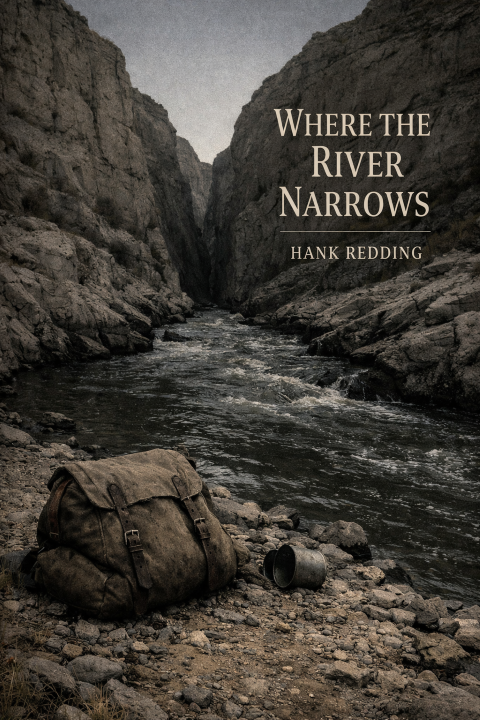
Where the River Narrows
Part I — The Wide Water
The river was already moving when Ellie reached it.
She came down through a low cut in the bank just after morning, the prairie opening wide behind her, the grass laid flat by a wind that had not bothered to stop overnight. The Missouri lay below, broad and slow in this reach, its surface the color of worked clay, carrying long seams of current that folded back into themselves without hurry. Cottonwoods lined the near bank in uneven runs—some standing, some fallen, their roots torn loose and held in place only by silt and habit.
Ellie stopped where the ground gave way to sand and gravel. She stood there longer than she needed to, pack still on her shoulders, feeling the weight settle into the places it always did: collarbones, hips, the old ache along her right knee that had never set clean after a winter fall. The river did not acknowledge her arrival. It continued on at the same pace, neither swelling nor thinning, neither offering nor refusing.
That suited her.
She walked down to the water and knelt, testing the edge with her fingers. Cold, but not sharp. She dipped her tin cup and drank without waiting, swallowing fast enough to avoid tasting the mud. The sound of the river filled the space around her, a low, constant movement that made distance feel measurable again.
She stayed on the near bank and turned east, letting the river lead.
By midday the sun had burned the wind down to a steady push at her back. She walked with it, keeping the water in sight, close enough to hear but not so close that the bank crumbled under her feet. When the ground softened, she stepped inland, following faint wagon ruts pressed into the grass years earlier when freight still moved this way. When the ruts faded, she followed game trails—deer, antelope, cattle—anything that suggested passage without promise.
She did not hurry. She had learned the cost of that.
By late afternoon she had covered maybe ten miles. She found a stand of willows bent low toward the water and set her pack down. The place offered no shelter worth naming, but it broke the wind, and the ground was dry enough to sit without sinking. She spread her blanket, ate dried meat and beans from her tin, and watched the river carry branches and debris past her knees. A dead cottonwood floated by, its bark stripped pale, rolling once before settling back into the current.
She thought of nothing in particular. That was new enough to notice.
When the light went thin, she took the flask from her pack and tipped a careful measure into her mouth. The laudanum dulled the ache without taking her legs. She lay back and let the river sound close over the edges of her thoughts. Somewhere upstream a bird called, then stopped. The prairie went quiet in the way it did before night fully claimed it.
She slept in short stretches and woke often, checking the river by sound before closing her eyes again. It was still there each time.
The next morning she walked on.
The land opened even wider as she moved east, the valley flattening until the river seemed almost hesitant in its course, wandering through its banks as if unsure which direction mattered. She passed old campsites—fire rings grown over, scraps of rusted tin—left by men who had stayed long enough to believe the river would provide more than it ever had. She did not stop at them.
Near noon she came upon a ranch set back from the bank, its fields pressed into uneven order, a fence leaning where the ground dipped. The garden nearest the house had gone to weeds, tall and stubborn. A woman stood in the shade of the porch, watching Ellie approach without calling out.
Ellie did not explain herself. She asked if there was work.
There was. Always was.
She stayed a week.
The work was ordinary and good enough—pulling weeds, mending harness, stirring pots that had burned before. The woman did not ask questions, and Ellie did not offer answers. They ate together in the evenings, the sound of cutlery and chewing filling the spaces where talk might have gone. At night Ellie slept in a small room off the kitchen, the window cracked open to the river air.
On the seventh morning she rose before light, packed what she had brought, and left the things she could not carry back on the table. She stepped away from the house without looking behind her, the river already visible beyond the trees, broad and waiting.
It was easier to leave when the water was near.
She reached the bank by full daylight and turned east again, keeping the river on her left. The current moved on, unchanged, and Ellie fell into step beside it, letting its steady pace set the measure for the miles ahead.
Part II - The Indifferent Crossing
She reached the ferry landing two days later.
There was nothing to announce it from a distance—no sign, no structure worth naming—only a widening of the bank where the grass had been worn thin and packed hard by hooves and wheels. The river drew closer to shore here, the current smoothing itself as if aware it was being asked to behave. A length of cable ran from one bank to the other, dark and slack in places, disappearing into the water before rising again on the far side.
Ellie stopped well back from the edge and watched.
The ferry was a flat thing, all boards and habit, tied off on the near bank. A man stood on it with his hands resting on the cable, waiting. He did not look at her at first. He watched the river instead, reading something in its surface that had nothing to do with her.
A wagon rolled down toward the landing, its wheels creaking, a family packed in close. The ferryman nodded once and put his weight into the line. The boat slid free, angling out into the current, the cable tightening as the river took hold and carried them across. Ellie followed the movement with her eyes until the ferry bumped the far bank and the wagon rolled off without ceremony.
When the ferryman looked back, he saw her.
“You crossing?” he called.
She shook her head. “Not here.”
He studied her a moment longer, then shrugged. “Won’t cost you.”
“I know.”
He waited, perhaps expecting her to change her mind. When she didn’t, he nodded again, already done with the exchange. Another rider came down the bank—a man trailing two horses, their heads low, the leather creaking softly as they stepped onto the boards. The ferry slid out once more, the cable singing faintly as the river pulled it taut.
Ellie turned away before they reached the far side.
Upstream, the river widened into a shallower run, the water spreading thin over gravel and sand. She walked until the ferry sounds faded, then stepped down into the current. The water pushed hard at her legs, colder than she expected, the pull steady and impersonal. She lifted her skirts and leaned into it, planting her feet where the stones held and letting the current pass around her instead of through her.
Halfway across she paused, feeling the river’s weight press against her knees, testing her balance. It did not hurry her. It did not resist her either. When she reached the far bank, she climbed out without looking back, the hem of her skirt heavy and dripping, her boots filling with grit.
She walked on.
By evening the sky had darkened to a dull, restless gray, the wind shifting without warning. Ellie found a cutbank where the river had undercut the earth, leaving a shallow overhang just high enough to sit beneath. She made her camp there, close enough to the water to hear it change its voice as the weather moved in.
The storm came hard and sudden. Rain flattened the grass and hammered the river surface until it lost its skin, turning rough and loud. Ellie pulled her blanket tight and pressed back against the dirt wall, watching the water rise inch by inch, swallowing the narrow strip of bank she’d crossed earlier without effort.
She did not feel fear. Only attention.
The river took what it needed and kept moving.
When the rain eased, the current had thickened, the seams tighter and faster. Branches and debris swept past, carried without comment. Ellie slept in short stretches, waking to the sound of water hitting the cutbank below her boots. Each time she checked the river, it was still rising, indifferent to her watchfulness.
By morning it had settled again, lower but changed, the crossing she’d used gone smooth and deep.
Ellie stood and drank from the river without kneeling this time, dipping her cup quickly and swallowing before the taste could linger. The water carried more silt now, heavier on the tongue. She packed her things and stepped away from the bank, following the river’s curve until the ground firmed again beneath her feet.
She did not think about the ferry.
She did not think about the crossing.
The river moved on, and she kept pace beside it, neither helped nor hindered, the distance ahead already measuring itself in her legs.
Part III - The Echo of Loss
She came upon the settlement in the late afternoon, where the river bent wide enough to slow itself again, as if considering rest.
There were four cabins set back from the bank, their logs darkened by weather and time, roofs held down with stones and habit. A small corral leaned toward the water, its rails worn smooth where hands and animals had passed too often. Laundry hung from a line strung between two cottonwoods, shirts and sheets lifting and snapping in the wind like signals meant for someone else.
Ellie stopped short of the open ground and moved into the willows instead, bending low where the branches met and the river sound softened. From there she could see without being seen. She had learned that much early.
A woman stood near the line, pinning clothes with practiced motions. She moved without hurry, shifting her weight from foot to foot as the wind pushed back. Two children ran along the bank, chasing a chicken that did not seem particularly concerned about being caught. Somewhere behind the cabins a man’s voice called out—not sharp, not kind, just present. The sound carried across the water and settled into Ellie’s chest before she could turn away from it.
She did not know these people.
That was not what unsettled her.
The scene required nothing of her. No explanation. No work. No endurance. It existed complete and indifferent to her passing, the way her own life once had.
Ellie stayed where she was until the wind shifted and brought the smell of soap and damp cloth down toward the river. She thought of the ranch she had left days earlier, the quiet meals, the way belonging could be offered without ceremony and accepted just as easily. She pressed her back into the dirt and waited for the thought to pass.
It did not pass quickly.
She made her camp farther downstream, tucked into a narrow pocket of trees where the bank rose steep enough to hide her fire. She ate sparingly and did not light the lamp. Across the water, the settlement’s sounds softened as evening came on—the children called in, a door shut, the faint clatter of a pot set aside. When the voices faded, the river filled the space again, steady and uninterested.
Ellie slept poorly.
She dreamed of coughing—not loud, not desperate, just the persistent sound of breath failing to clear itself. The sound followed her through the dream, never resolving into a face, never stopping long enough to name. She woke with her hand at her chest, fingers curled into the wool of her shirt, the river mist cold against her cheek.
She sat up and waited until the sound in her ears settled back into water.
At first light she packed and moved on, keeping to the far edge of the bank where the grass thinned and the ground broke unevenly underfoot. She did not look back toward the cabins. She did not tell herself why.
The river narrowed slightly beyond the settlement, the banks rising and closing in just enough to change how sound carried. The cottonwoods thinned. Trails that had once held wagons faded into nothing more than pressed grass and broken stems. Ellie walked slower now, measuring each step, the river closer at her side, its surface broken into tighter seams that moved faster than before.
By midday the sun had turned hard and white, the sky stripped clean of anything that might soften it. She drank and walked, drank and walked, the pack riding heavier as the land gave her fewer places to rest. She welcomed the work. It left less room for thought.
When she finally stopped, the river was louder than it had been that morning, its voice sharpened by stone and slope. Ellie sat and let it speak past her, the sound no longer broad or forgiving, but insistent, narrowing her attention whether she wished it or not.
She stood again before the light began to fail, turned east, and followed the river into ground that no longer made room for her as easily as it once had.
Part IV - The Tightening Corridor
The river changed its manner without warning.
Ellie noticed it first in the sound. What had been broad and even took on an edge—water moving faster than its surface suggested, breaking itself against stone she could not see. The bank narrowed and tilted, the easy gravel giving way to hard-packed clay and shale that slid underfoot if she trusted it too quickly.
She slowed.
The cottonwoods thinned until they no longer formed a line but appeared singly, then not at all, replaced by scrub and bent sage that offered no shade and little shelter. The river stayed close, but no longer companionable. Its voice rose and fell unpredictably, louder in the bends, quieter where it cut away from the bank, as if deciding how much of itself to reveal.
Ellie walked higher now, forced up onto benches that overlooked the water rather than meeting it. The climb cost her breath. Her knee flared where the ground slanted wrong, a deep, familiar ache that reminded her to place each step deliberately. She welcomed the pain for what it required of her—attention, balance, restraint.
From the bench she could see farther than before. The river threaded through pale stone and shadow, its course tightening between rising walls that caught the light and threw it back stripped of warmth. The sky narrowed too, pressed into a longer, thinner band above the bluffs. Ellie paused there longer than she meant to, measuring the distance between herself and the water below.
She did not like the height, but she did not hurry down.
The trail—if it could still be called that—faded into little more than broken stems and scuffed dirt. Where wagons had once passed, only memory remained, and even that was thin. She followed what signs she could: the slight depression where others had stepped, the angle of stones turned by hooves years before. When the path disappeared entirely, she picked her way forward on instinct and habit, trusting the river to reappear when it chose.
By midafternoon the sun pressed hard, the light flattening everything it touched. Ellie drank more often now, dipping her cup carefully where the current slowed enough to allow it. The water tasted sharper here, carrying less silt and more stone. She rinsed her mouth and moved on, conserving what strength she could.
She found no good place to stop.
Each bend offered less than the last: banks too steep, ground too loose, exposure too complete. When she finally settled for the night, it was on a narrow shelf of dirt backed by rock, the river several feet below and out of reach unless she climbed down to it. She ate quickly and sat with her back against the stone, listening to the water speak in short, forceful phrases.
Sleep came in fragments. The river sounded closer than it was, louder than it had any right to be, as if working itself into a narrower shape just beyond her sight. Ellie woke more than once with her hand braced against the rock, steadying herself against nothing that moved.
At dawn she rose stiff and quiet, her knee slow to answer her weight. The sky was already pale, the light reaching down the bluffs in thin sheets that missed the river entirely. She watched the shadow hold where the water ran, dark and intent, and felt a brief, unreasoned relief that she was not required to cross it.
She climbed down carefully, testing each foothold before committing. When she reached the bank, the river was closer and faster than it had been the day before, its surface broken into tight seams that refused to smooth themselves. Ellie stood there, considering the line of it, the narrowing course ahead already written in the stone.
She did not linger.
The land gave her fewer choices now, and she took the ones that remained, following the river into ground that pressed back against her steps—not yet impassable, but no longer willing to make room.
Part V - Where the River Narrows
The river refused her before it stopped her.
Ellie saw it coming in the way the walls drew closer, the stone rising straighter from the water, leaving no margin for mistake. The bank thinned to nothing more than broken rock and sharp angles, the river pressing hard against it, loud and impatient. Where she might once have picked her way along the edge, there was now only water and height, the current driving itself forward without regard for footing or pause.
She walked until she could not.
The last place the land allowed her to stand was a narrow spit of gravel pushed up against the bend, barely wide enough to rest both feet without testing the edge. Beyond it, the river tightened into a rush, shouldering its way between walls that climbed too steep to follow and dropped too fast to trust. The sound filled the space completely, leaving no room for thought.
Ellie set her pack down and stood there as the light drained from the stone.
She did not try to cross.
She did not look for another path along the water.
She waited.
Dusk came quickly in the narrows, the sun slipping away behind the walls until only a narrow strip of sky remained overhead, pale and distant. The river darkened first, its surface losing definition, its voice growing heavier as the day released it. When night finally settled, the stars appeared all at once in the thin opening above—sharp, cold, unblinking.
Ellie listened until the river’s sound became something she no longer needed to measure.
When she moved, it was not toward the water and not back the way she had come. She turned aside, toward a faint cut in the stone where a narrow draw climbed away from the river, its mouth half-hidden in shadow. The ground there was steep and uncertain, but it offered a direction the river no longer did.
She lifted her pack, settled the weight, and took the first steps up the coulee carefully, testing each foothold before committing. Loose stones shifted under her boots and slid away toward the water, disappearing into the sound below. She did not follow them with her eyes.
Behind her, the river kept moving, pressed into its narrow course, its voice already fading as the land rose between them.
Ellie climbed until the draw bent out of sight, the river’s sound reduced to a distant murmur, then nothing at all.
She did not stop when it went quiet.