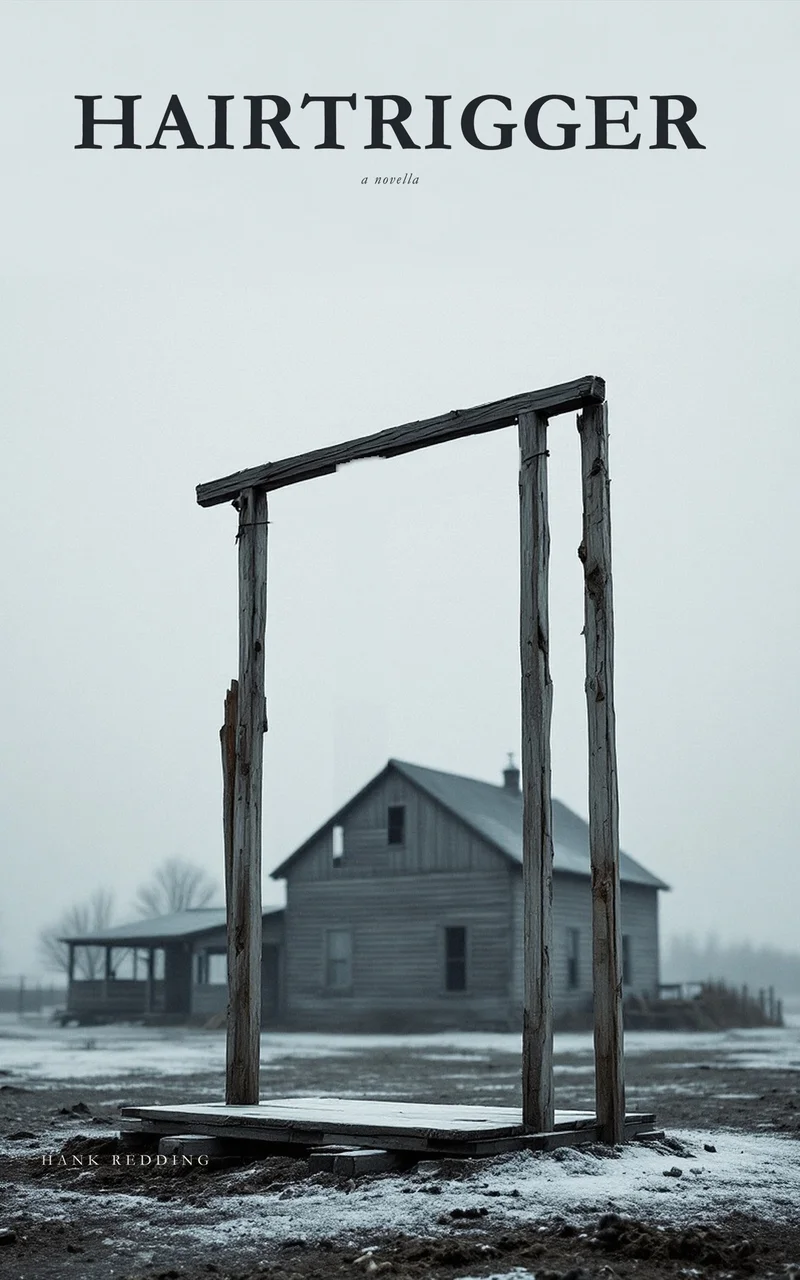
Hairtrigger
A Novella
By morning he will have told the story of his life twice: once the way he has always told it, and once the way it happened.
Free with Kindle Unlimited • Kindle edition $3.99 • Paperback on Amazon
Halden, Nebraska, November 1879. In a cell that faces the courthouse yard, a condemned man lies awake and listens to carpenters build the gallows that will hang him at dawn. Hammer, then saw, then hammer again — and every strike pulls him back into a life he has spent years learning to tell one particular way.
Read more
Amos Deakins was a good shot long before the war ever taught him to kill on command. At Champion Hill an officer gave the order, he fired, a man died, and everyone agreed that was right. He came home in 1865 to a farm that had learned to run without him, drifted west into the railroad camps, and somewhere out there found the thing the war had left him fit for. The first time he killed a man with no one near enough to give the order, he told himself it was reflex. Years later, with dawn coming on, he is no longer sure that was true.
By morning he will have told the story of his life twice: once the way he has always told it, and once the way it happened.
Hairtrigger is a spare, unsparing novella about the distance between the man who fires on an order and the man who learns to give himself one — and how short that distance turns out to be.
Read the opening
They moved me after supper, when the light was going out of the window at the end of the hall and nobody had lit the lamps yet.
I did not ask why. There was no why worth the asking. I had been three cells down for going on fourteen months, close enough to the stove that I knew its particular clank when Pruitt fed it in the mornings, and now they wanted that cell for somebody else, or they wanted me somewhere they could see the door of easier, or somebody upstairs in Lincoln had written a word on a piece of paper and the word meant move him. It came out the same regardless.
The walk from the old cell to the new one was eleven steps, past the open door of the office where a lamp already burned low on the desk, past a second cell standing empty that had held, until that afternoon, a drunk named Purvis who’d broken up a table at the Elkhorn two nights running and whom Pruitt had turned loose that morning rather than keep underfoot for what was coming. I noticed the empty cell. I noticed the desk, and the strongbox under it, and the locked drawer above the strongbox, without any particular thought about what any of it held, and a man’s hand at my elbow the whole eleven steps that wasn’t unkind so much as it was simply making sure of where I was.
The new cell faced the yard. I understood that part on my own, once I was in it.
It was smaller than the old one, or it only felt that way because I hadn’t worn a groove in the floor of it yet. Cot against the near wall, straw gone flat and gray with use, a blanket that had been somebody else’s blanket first and hadn’t forgotten it. A bucket in the corner. A window up high, no wider than my two hands laid flat, with bars set into it that had rusted at the base where the rain got in. I could reach the sill if I stood on the cot, which I did once, briefly, and then didn’t again, because there was nothing up there but a strip of darkening sky and the top of the courthouse roof and I already knew what was underneath it.
Pruitt came in behind the man carrying my blanket and stood with his thumbs in his belt while the fellow got it settled on the cot. He didn’t say anything until the other man had gone back out and shut the door most of the way, leaving it on the latch instead of the bolt, which was its own kind of statement, though I didn’t know yet what it was saying.
"Cell’s dry," he said. "Roof on this side don’t leak like the other one."
"All right."
"Turned Purvis loose this morning. Didn’t figure a man sleeping off a Tuesday drunk needed to be part of what’s happening around here the next day or two." He said it plain, the way he said most things, not looking for any particular response to it, and I didn’t give him one.
"Supper’ll come the same as always. Nothing different about tonight, far as that goes." He looked at me like he was deciding whether that last part was true, and then like he’d decided it wasn’t, but he let it stand anyway. "Word came back from Lincoln three weeks gone, if you want to know it official. I expect you already knew it."
"I knew it."
"All right, then." He nodded once, more to himself than to me, the way a man nods over a fence he’s just checked and found sound. "You want the preacher sent for, you tell me any time between now and morning. Don’t matter what hour."
"I heard you the first time you asked."
"I know it. I’m asking again anyhow. It’s my job to ask it more than once." He said this without any heat in it, the way he might have told me the cell was dry, and went to the door. Then he stopped with his hand on it and looked back, not at my face but somewhere around my boots. "Those still not fitting you right?"
More from Hank Redding
-
 The Settled Dust
Kindle Unlimited
-
 The Reckoning of Silver Butte
Kindle Unlimited
-
 The Weight of the Record
Free to read
-
 The Road Between
Kindle Unlimited
Or start free with Just Onward, a short story. All the books · All the open stories
When a new story goes up
Leave an email and I’ll write when there’s a new story. Nothing else, and you can leave any time.
Or follow by RSS.