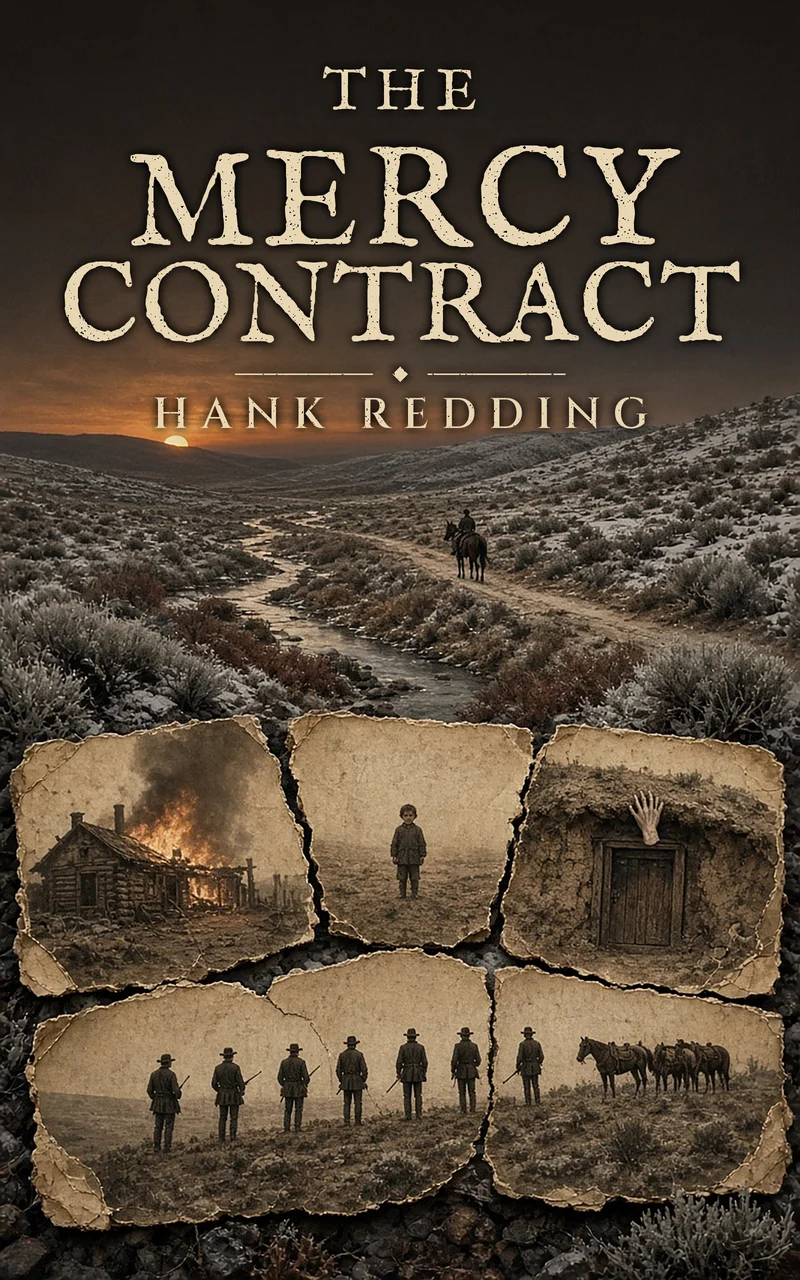
The Mercy Contract
Three strangers, three torn pieces of one photograph, and one word on the back of each: Remember.
Free with Kindle Unlimited • Kindle edition $4.99 • Paperback on Amazon
In the fall of 1881, three strangers arrive in a dying Nevada town, each carrying a torn piece of the same old photograph. On the back of every piece, someone has written one word: Remember.
Read more
Abigail Kern treats the sick without a license and keeps a bottle of laudanum in her coat. Fifteen years ago, in a wagon darkroom, she developed that photograph while men on the ridge fired into a winter camp. Moses Pitts hunts men for bounty now. Back then he wore a deputy's badge, and he wrote the report that called the killing something else. Henry Childress is nineteen, cannot read, and stutters on the questions no one in town will answer. The child in the photograph has his face.
Providence was founded on a contract signed after that morning: silence, on forfeit of each signer's life, and a promise that in fifteen years the surviving boy would be told the truth. The term comes due at sundown on November 17. Whoever tells Henry what happened will die. If no one tells him, everyone who signed will.
Jacob Ware, the last powerful founder, means to sell the town before then, and to get Henry's mark on that same paper or put Henry in the ground.
The Mercy Contract is a Western Gothic historical mystery for readers who like literary westerns, hard-won justice, and old crimes buried beneath respectable towns.
Read the opening
Abigail recognized the ridge before the driver named it.
The stage had been climbing since noon, trading the broad alkali flats for a road that bent between low brown hills. Dust entered wherever the coach had come apart by degrees: through the window curtains, through the split below the door, through seams in the roof that showed daylight when the body rolled. It settled on Abigail’s sleeves and worked into the hinge of the medical case beneath her boots.
Across from her, a drummer out of Sacramento slept with his chin against a wooden sample box. Each turn tipped him toward the aisle. Each time, he woke enough to catch himself and then went under again. The woman beside him had spent the last hour holding a handkerchief over her mouth.
Abigail watched the country through the gap in the curtain.
The ridge rose in three steps above the creek basin, the middle rise cut flat at one end as if a blade had been passed through it. She had first seen that shape upside down beneath black cloth. Edwin had been pleased with the line of it. He had moved the camera twice, carrying one leg of the tripod at a time while she guarded the plate bath from the wind.
That had been November. The sage had gone gray with frost, and the creek below the ridge had shown white at its edges.
Now the ground was September-yellow. A wagon road crossed the lower slope. Telegraph wire ran beside it, lifting and falling from pole to pole.
The ridge had not changed enough.
“Providence Ridge,” the driver called through the front opening. “Town in half an hour.”
The woman lowered her handkerchief. “That all?”
“That is what they paid to call it.”
The driver’s answer brought no laughter. He snapped the reins once, without much conviction, and the team leaned into the grade.
Abigail put one boot against the medical case before the next rut could move it. The leather was cracked at both corners and darker where old solutions had spilled. A strap Edwin had replaced with harness leather in Virginia City still held. Nothing else he had repaired had lasted as long.
In her coat pocket, glass touched metal with a small sound.
She pressed her hand over it.
The bottle was wrapped in a square of flannel. The tintype case was not. Their edges had struck together since Battle Mountain, no matter how Abigail arranged them, until she had begun to hear the contact before it came.
Glass. Metal.
Then the coach wheel found stone, and the whole body lurched left.
The drummer’s sample box slid from his knees. Abigail caught it against her shin before it overturned.
He woke swearing and grabbed for the handle.
“You can have it,” she said.
He pulled the box close. “There’s bottles in there.”
“You might hold it as if there are.”
He looked at the case beneath her boots. “You sell remedies?”
“No.”
“Midwife?”
Abigail drew the curtain farther aside.
The first roof appeared below them.
“Sometimes,” she said.
Providence sat along the creek in the order of its ambitions. The mill came first, upriver, its stack standing over a long shed silvered by weather. A thin thread of smoke leaned from it and dispersed before it cleared the roof. Below that were the mine office and ore bins, then houses arranged on two graded streets. The commercial buildings faced one another across a main road wide enough to turn freight teams. At the south end, roof joists stood over the stone walls of an unfinished building. Beyond it, the ground opened into corrals and scattered cabins.
From the ridge the town appeared intact. Nearer, Abigail saw the failures.
Two houses had boards over their windows. A porch roof sagged above a dry-goods sign. Wind had stripped half the tar paper from the unfinished building’s partial roof deck and worried the remaining sheets into black flags. The mill pond had withdrawn from its upper bank, leaving a pale ring around the mud.
More from Hank Redding
-
 Hairtrigger
Kindle Unlimited
-
 The Settled Dust
Kindle Unlimited
-
 The Reckoning of Silver Butte
Kindle Unlimited
-
 The Weight of the Record
Free to read
Or start free with Just Onward, a short story. All the books · All the open stories
When a new story goes up
Leave an email and I’ll write when there’s a new story. Nothing else, and you can leave any time.
Or follow by RSS.