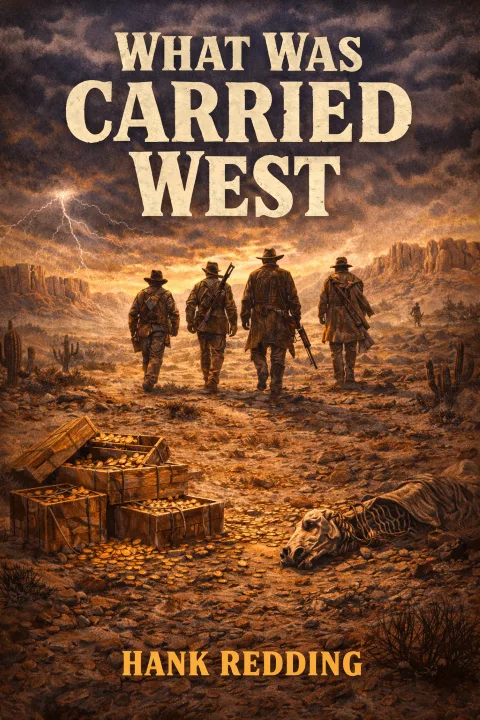
What Was Carried West
A Novella
Four men walk away from a wrecked gold wagon. One of them has picked up a single coin.
Free with Kindle Unlimited • Kindle edition $3.99 • Paperback on Amazon
A storm breaks over a gold wagon on a desert freight road. When it passes, the driver is dead, the company man is gone, and the gold lies in the mud.
Read more
Four men walk away from the wreck. One of them has picked up a single coin.
They have a canteen apiece, a crate no one has opened, and a long stretch of road with no water anyone knows of. Behind them is a rock tank someone else keeps. Ahead of them is the arithmetic of who can still walk.
The men have names. The book never writes them down.
What Was Carried West is a spare, cold Western about weight: the kind a man carries on his back and the kind he carries in his pocket.
Read the opening
The wagon had been groaning for hours before the storm showed itself.
It was not the sort of sound that suggested danger—only fatigue. Wood complaining beneath iron, axles warming and cooling with each slow rotation, the faint, uneven rhythm of a load heavier than it looked. The men walking alongside it did not speak of it. They had learned, long ago, that wagons were like animals: you listened, you adjusted, but you did not ask too much.
Dust rose with every step. It clung to cuffs and bootlaces and the hems of coats, settling into creases where sweat had darkened the fabric. By late afternoon, the desert smelled faintly metallic, the way it always did before rain—an old warning no one trusted anymore.
The sky to the west had begun to thicken.
Not dark, exactly. Not yet.
Just crowded.
Clouds stacked on one another like unspoken thoughts, their edges bruised purple and copper where the sun pressed against them. The light had gone strange—flattened, dimmed, as though the day had decided not to finish properly.
Someone remarked on it. Someone always did.
“Won’t amount to much,” a man said from horseback, pulling his hat lower as the wind shifted. He sounded hopeful. Storms meant delays. Delays meant risk.
The wagon carried gold.
Not in chests marked by symbols or seals. Not in anything ceremonial. It rode inside plain crates reinforced with iron bands, stenciled only with weight. Coins wrapped in cloth. Bars cushioned with straw. Wealth reduced to mass and friction.
It had passed through many hands already, none of them sentimental.
The driver sat high, reins loose, his shoulders hunched against the wind. He had driven freight for most of his adult life and had learned to keep his eyes on the ground more than the horizon. Trouble rarely announced itself from far away. Trouble arrived from the edges—behind rocks, beneath intentions, inside men who had already decided what they would do when the moment arrived.
There were seven of them to see the gold the rest of the way.
The driver on the box. The man on horseback—the company’s man, the only horse not in harness—riding a little ahead and off to the right, where he could turn in the saddle and look back at the crates as often as he liked, which was often. He carried the bill in the inside pocket of his coat, folded in oilcloth, and touched it now and then through the cloth the way some men touch a healing cut to see whether it has closed.
Five men walked.
One walked forward on the left, near the lead team, his rifle carried across his arm. He had a cough he had brought down from the mine and a habit of humming hymns without the words. No one had asked him to stop. By now no one heard it anymore.
Behind the man on the left, at the near wheel, walked an older man, thick through the shoulders, who had driven freight himself until his back gave him a reason to walk beside it instead. He walked with one hand out sometimes, not quite touching the wheel, the way a man walks beside a horse he knows.
A younger man kept close to him. He had attached himself to the older man on the first morning out of the mine, the way young men attach themselves to whoever seems least likely to laugh at their questions, and he had been asking questions ever since.
Out front, far enough ahead that the heat sometimes took him, walked a man who said almost nothing. He kept his eyes on the ground and read it the way other men read newspapers—quickly, without comment, missing nothing that would matter later.
And at the back, on the right, near the tailboard, walked a man who watched the edges.
He had asked for the back. It was the place where a man could see everything else that was moving and not be seen watching it. From there he could see the company man’s hand go to his coat. He could see the driver’s shoulders. He could see the ridgelines on both sides and the long road unspooling behind them, empty and pale, and he could count the crates without seeming to count them.
More from Hank Redding
-
 Dust Will Tell
Kindle Unlimited
-
 The Last Good Rope
Kindle Unlimited
-
 Car No. 47
Kindle Unlimited
-
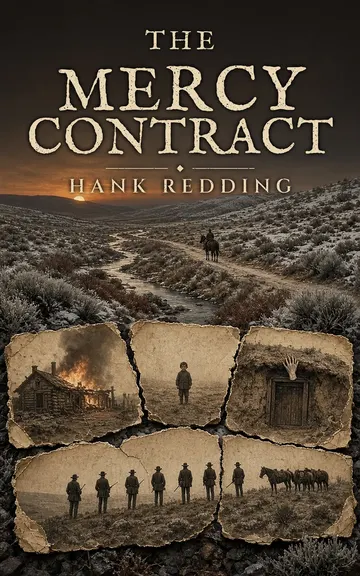 The Mercy Contract
Kindle Unlimited
Or start free with Just Onward, a short story. All the books · All the open stories
When a new story goes up
Leave an email and I’ll write when there’s a new story. Nothing else, and you can leave any time.
Or follow by RSS.